Computing in Melbourne: A Historical Tour
Graham Farr, Barbara Ainsworth, Chris Avram, Judy Sheard
Monash Museum of Computing History,
Faculty of Information Technology, Monash University,
Caulfield East, Victoria 3145, Australia
Graham.Farr@monash.edu
Melbourne has several remarkable links to the earliest days of computers.
Here we describe a tour that takes in many of these
places, and can be done by a combination of walking and tram travel.
The tour is a chance to explore another dimension of Melbourne's
history and to better understand how computers have changed
science, business and society.
From time to time we organise group tours to visit most of
the places described here.
The tours are free (apart from the cost
of tram travel and whatever you may buy at cafes on the way),
but bookings are essential as capacity is limited.
If you would like to join a future organised tour, please
register your interest at
https://docs.google.com/forms/d/e/1FAIpQLSfyqbMt_pRaEVnKaYW2XJiQFZHF0UqFAT6tswMc4QDmTR0qrw/viewform.
Alternatively, you can use this web page to do a self-guided tour.
We would like to know how it goes!
We have written an article about computer history tours,
including some advice on how to run them in other cities.
See:
http://dl.acm.org/citation.cfm?id=2844575 (open access).
The remaining tours for 2019 are now CLOSED as they are full.
You can use the form, at the above link, to register your interest in a future tour.
Contents
Overview
SOUTH
1. Monash Museum of Computing History
2. Site of Albert Park Barracks and DSD
3. Melbourne's Silicon Mile: St Kilda Road and Fitzroy Street
4. Stanhill
5. Wartime codebreaking by FRUMEL and Central Bureau
6. Melbourne Observatory: Melbourne's first computer room
7. Victoria Barracks: Australia's first supercomputer
CITY CENTRE
8. St Paul's Cathedral: the Babbage connection
9. Site of National Mutual: Smalltalk-80's Australian debut
10. Site of Australia's first telegraph
11. Lonsdale Exchange
12. State Library of Victoria: Vicnet and Pictoria
13. RMIT's first computer, and the arrival of ALGOL 60
14. Bureau of Meteorology: computing the weather
15. ICI House
NORTH
16. MONIAC, a hydraulic analogue computer for economic modelling
17. Old Physics, University of Melbourne: CSIRAC's first
Victorian home
18. Physics Museum, University of Melbourne
19. Site of Australia's first internet connection
20. The Royal Exhibition Building: Hollerith machines and the 1921 census
WEST
21. Scienceworks: CSIRAC
Previous organised tours
Acknowledgements
References
Overview
The tour starts at the Monash Museum of Computing History, at the Caulfield
campus of Monash University, south-east of the city centre. After a tram
journey to St Kilda Road, this first (south) section of the tour follows
a sequence of sites up St Kilda Road (with some small detours) until
it reaches the city centre at St Paul's Cathedral. After that, you can either
- visit some of the
sites scattered around the city centre,
in whatever order suits you, then continue to the North section
of the tour, including University of Melbourne and the Exhibition Building, OR
-
go West to Scienceworks, to see CSIRAC. You can either take the train from
Flinders Street Station to Spotswood, or catch a commercial ferry from Southbank
to Scienceworks. The ferry option is a great journey but the ferries run
less frequently and require more time, money and preparation.
The tour is inspired in part by the excellent Mathematics Tour devised by Jill
Vincent [27], though the emphasis of that tour
is more on mathematical education and exposition than history. There
is also a fascinating article on historical sites for Physics in Melbourne by
R W Home [16]. Readers may wish to combine elements
of the various tours according to taste.
For a list of previous organised tours,
see below.
Suggestions of further places for such tours are always welcome:
please email them.
To get to the Monash Museum of Computing History,
to start the tour:
first, go to the Caulfield campus of Monash University;
then find Building B.
- Catch a train on the Dandenong/Cranbourne/Frankston line
to Caulfield station. Come out onto the north side of the station, walk
east along Sir John Monash Drive,
turn left into Queens Avenue at the roundabout,
walk a short distance north until the stairs on your right.
These stairs lead up to Building B.
- Catch tram number 3 or 3a, and get off at stop 59.
Cross Dandenong Rd and walk south into the campus, proceeding along
Queens Avenue until you reach the stairs on your left, just before the
roundabout, that lead up to Building B.
- Catch bus 624 or 900, get off in Sir John Monash Drive
(near Caulfield station), walk east along that road,
turn left into Queens Avenue at the roundabout,
walk a short distance north until the stairs on your right.
These stairs lead up to Building B.
- Drive and park where you can. On weekends,
it usually isn't too hard to find a spot in Dandenong Rd,
either by the roadside or (paid parking) in the campus's
multi-storey car park (bldg J). See Melways Ref. 68F1.
There is a detailed map of the Caulfield campus at
http://www.monash.edu/__data/assets/pdf_file/0003/71688/2-Caulfieldcolour.pdf.
Comprehensive information on transport to Caulfield campus is at
http://www.monash.edu/__data/assets/pdf_file/0003/58773/caulfield-transport-map.pdf.
SOUTH
1. Monash Museum of Computing History
The
Monash Museum of Computing History
(MMoCH) was established in 2001
by the Faculty of Information Technology, Monash University. The broad
aims of the Museum are to establish a collection of historical reference
material, create an educational program for students and the general
public on the social impact and technological developments in computer
history, and collect information on the development and use of
information technology at Monash University.
 The Museum has a permanent exhibition in Building B at the Caulfield
campus of Monash. This display features both the technological
development of computing and the social impact of these developments
over the last 50 years. The display has both computing and calculating
material and includes a showcase focusing on the achievements of Monash
staff connected with computing.
The Museum has a permanent exhibition in Building B at the Caulfield
campus of Monash. This display features both the technological
development of computing and the social impact of these developments
over the last 50 years. The display has both computing and calculating
material and includes a showcase focusing on the achievements of Monash
staff connected with computing.
More information about the Museum can be found at
http://www.infotech.monash.edu.au/about/museum .
The Ferranti Sirius computer
The most significant piece in the Museum collection is the Ferranti
Sirius computer which was purchased by Monash University in 1962 and was
the first computer owned by the University. The relocation, reassembly
and display of this computer was a major project conducted by the Museum
team. The provenance of the computer is the focus of an ongoing
research project of the MMoCH.
The English company Ferranti Ltd produced a range of computers in the
early 1960s, each named after mythical figures, including Perseus,
Pegasus, Sirius, Orion and Atlas. Ferranti developed its own
transistorized circuit under Gordon Scarott during the late 1950s
which incorporated neuron circuits into a test-bed computer under the
code name NEWT. This technology was later used in the development of
the new Ferranti computer, the `Sirius'. It was
announced to the public in a press release on May 19, 1959. It
offered the Sirius as a transistorized desk-sized electronic digital
computer. The release claimed that it would be the smallest and most
economically priced computer in the European market.
 The MMoCH Ferranti Sirius is displayed in a dedicated showcase and
includes the 1,000 word CPU (where each word is 40 bits, so the amount
of RAM is 40,000 bits, i.e., 5,000 bytes)
and an additional 3,000 word memory cabinet
along with a suite of editing equipment. The memory takes the form of
acoustic delay lines, in which bits are encoded as acoustic pulses
which are repeatedly sent along some "track". Here, the track is
a long wire (which you see here coiled in a tray), and the bits become
momentary twists that are carried along the wire like a wave.
The MMoCH Ferranti Sirius is displayed in a dedicated showcase and
includes the 1,000 word CPU (where each word is 40 bits, so the amount
of RAM is 40,000 bits, i.e., 5,000 bytes)
and an additional 3,000 word memory cabinet
along with a suite of editing equipment. The memory takes the form of
acoustic delay lines, in which bits are encoded as acoustic pulses
which are repeatedly sent along some "track". Here, the track is
a long wire (which you see here coiled in a tray), and the bits become
momentary twists that are carried along the wire like a wave.
The Sirius display is supported by
a short film produced in 1963 that explains the operations of the
Sirius for a non-academic audience.
There were actually four different Sirius computers on campus at different
times over the 1960s. These four computers were located at different
sites in 1962 with two Sirius computers at the Melbourne Computer
Centre operated by Ferranti Ltd, one at Monash University's Clayton
campus and one at a commercial research operation run by ICIANZ, now
called ORICA, at Ascot Vale. Through loan, donation and sales all
four were used by Monash University.
In 1962 Monash University purchased a Ferranti Sirius computer for the
new Computer Centre. While it was being manufactured, Ferranti
Ltd's Melbourne office placed their Sirius machine on
campus. The University's own computer was installed in
November 1962. The machine was kept busy with both administrative and
academic work. Meanwhile ICIANZ gave the University their Ferranti
Sirius in 1967 as they had updated their own equipment. This second
Sirius was placed in the Department of Chemistry or Chemical Engineering.
These two machines
were gradually used less and less and were finally decommissioned in
1972. The Computer Centre machine is now in the MMoCH museum display
and the ICIANZ machine was given to Museum Victoria in 1975.
Caulfield Technical College (now Caulfield campus, Monash University)
also used a Ferranti Sirius from 1963. It was on lease then later
purchased outright from the Ferranti Ltd Melbourne office. This
machine was a popular exhibit on Open Days. It was replaced about
1969 and its final fate is unknown.
Further information is available in a
paper by Barbara Ainsworth
[1].
To next stop:
On leaving the Museum, go to nearby
Dandenong Road and catch a tram westwards (heading
towards the city, with `University' on the front, on the tracks
closest to the campus). These trams come about every 12 minutes
on weekdays and every 15 minutes on weekends (during most of the
day). Note the number of your tram: it should be 3 or 3a.
For longer tour,
visiting the old Albert Park Barracks site (item 2 of this tour):
If your tram from Caulfield is a No. 3,
will take about 20 mins to get to St Kilda Junction (Stop 30),
where you get off, take the pedestrian underpass towards the Junction Oval
and Albert Park. There are a number of footpaths through the parks here.
Walk south-west (parallel to Fitzroy St), cross Lakeside Drive, turn
right sometime afterwards and the path will take you to the part of the
park formerly occupied by the Albert Park Barracks and DSD.
If your tram from Caulfield is a No. 3a,
the journey will be longer (about 30 mins),
and you detour via The Esplanade, with
great views of St Kilda Beach and the bay,
before coming up Fitzroy St towards St Kilda Junction. Get off at
Stop 132 and walk into Albert Park, keeping Lakeside Drive on your right.
(Note that Fitzroy St itself used to be home to some significant
computer companies: IBM, Burroughs, Interdata. See
below for more information.)
For shorter tour, straight to
Stanhill (item 4):
If your tram from Caulfield is No. 3, the
journey from Caulfield should take about 25 mins; if it is No. 3a,
the journey should take 35-40 mins.
Stay on the tram past St Kilda Junction. Once you pass the Junction,
you will also soon pass the former locations of a number of computer
companies: see the list at Item 3
for a description of these.
(In fact, if you are on a No. 3a tram, you will also see a few such
locations in Fitzroy St before you reach St Kilda Junction.)
Get off the tram a bit later at Stop 25, just after Commercial Road comes
in on the right with Albert Cricket Ground on the left.
Find Hanna Street nearby, on the same (west) side of St Kilda Rd
as the cricket ground and tennis courts, and just north of them.
Enter Hanna St there and go to the end,
where it meets Queens Road. On this corner, on your
right, you will see Stanhill.
(On the other side of Queens Road
is part of Albert Park, its public golf course. Somewhere in
Albert Park is the former location of Albert Park Barracks.)

2. Site of Albert Park Barracks and DSD
The Defence Signals Directorate (DSD)
used to be located
at Albert Park Barracks, which used to be in the south-west part of
Albert Park (Melways Refs. 2N K1-K2 and 2P A2-A3). DSD made intensive use
of computers and communications equipment to intercept
and decrypt foreign communications. There is very little
publicly available information about this, but some general
historical information is at
http://www.asd.gov.au/about/history.htm .
DSD moved to Victoria Barracks
in St Kilda Road, Melbourne, in 1979; see
below. It moved to Russell
Defence complex, Canberra, in 1993.
The Albert Park Barracks were built in WWII and were demolished after DSD
moved to Victoria Barracks. The site is now parkland and includes
several sporting fields.
While in the area, if you are interested in the former locations
of computer companies, then go to nearby Fitzroy Street and see
the sites there that are mentioned below.
Then travel by foot or tram to St Kilda Junction, then north
(towards the city) along St Kilda Road, where again you can see
some former computer company sites on the way (see next item).
3. Melbourne's Silicon Mile: St Kilda Road and Fitzroy Street
In the 1960s and 1970s, many computer companies established
offices and service bureaus along the stretch of St Kilda Road
between St Kilda Junction and the Shrine of Remembrance, with
a few in Fitzroy Street, St Kilda, which meets St Kilda Road
at the Junction.
We give the locations of many of these, though many of the buildings
and companies mentioned no longer exist. If interested, you can
spot some
of the sites from your tram window, or while walking up St Kilda
Road.
Moving from south to north:
We begin in Fitzroy Street,
but if you are staying on the tram through St Kilda Junction,
then skip to the St Kilda Road addresses below.
161 Fitzroy St: Burroughs, early 1960s. Burroughs
had a close working relationship with Monash University
Computer Centre which operated a number of Burroughs
computers during the 1970s.
173 Fitzroy St: IBM, early 1960s to late 1970s.
217 Fitzroy St: Interdata, late 1970s. Interdata was a division
of Perkin Elmer Data and supplied
32-bit minicomputers.
598 St Kilda Rd (corner of Lorne St):
Control Data Australia (CDA), 1965-1982. The
building still stands. It originally had five storeys.
An extra storey was added
and converted to apartments in the 1990s.
The building is now `Parklake Towers' apartments.
There is a strong community of ex-CDA employees, with
an excellent
website at
http://excda.site44.com/. The website contains several articles on the history of
Control Data and the Australian computer industry.
Ex-CDA employees are invited to use the website to help them keep in touch.
574 St Kilda Rd: Unisys, 1980s. This was called the `Unisys Centre'
and used to house an office of Novell.
568 St Kilda Rd: ICT (later ICL), from 1962.
509 St Kilda Rd: NCR data centre, 1960s.
34 Queens Rd, at corner with Hanna St, on the north side of
the Albert Cricket Ground: Ferranti, early 1960s.
See next item on Stanhill.
499 St Kilda Rd: General Automation Australia, late 1970s.
They sold micro-programmed 16-bit general purpose computers.
493 St Kilda Rd: Control Data Australia, 1982-89. CDA moved
here from 598 St Kilda Rd.
474 St Kilda Rd: Control Data Corporation (CDC), early 1960s.
The local arm of CDC became CDA. Its Australian Head Office
was in Suite 16 (later, 17 and 18 too), Eton Square,
at this address. CDA later leased 598 St Kilda Rd.
464 St Kilda Rd (VACC building): Data 100, 1970s.
Data 100 produced Remote Batch Terminals for use with
various mainframe computers and other terminals.
445 St Kilda Rd: Digital Equipment Corporation (DEC), from 1967.
DEC introduced the successful PDP-8, generally regarded as the
first minicomputer. The building that housed DEC here has long
since been demolished.
412 St Kilda Rd (Mayne Nickless building): Univac, late 1970s and 1980s.
400 St Kilda Rd (near Domain Interchange): Honeywell, from 1960s.
Honeywell's office included a ground floor computer room with
a large glass window facing St Kilda Road.
Honeywell became a target of protesters against the Vietnam War, due to its
US parent company's involvement in supplying the US military. Protest marches
down St Kilda Road --- from Flinders St to the US Embassy further south ---
used to pause outside Honeywell, which was a convenient mid-way point.
John Sheehan (Systems Manager there at
the time) recalls that protesters
threw Molotov cocktails,
A more serious incident occurred on the night of 30 June 1970, at about 2:30am,
when a shotgun blast damaged a plate glass window and hit the CPU
of a time-sharing computer, fortunately missing an engineer who was
working on it at the time. It took 9-12 months to fix.
Max Burnet writes that
"No company in Melbourne ever built a ground floor computer room
again."
A later threat to Honeywell resulted in at least three computers being placed
on trucks and moved around the city area all night (as no-one would accept
them into temporary storage because of fear of protest action).
Honeywell moved out of here at the end of 1974. The building was replaced
in 1975. Initially, the new one had five storeys; three more were added
during refurbishments in 1996-97. The building became an apartment block,
named `Botanica', which still stands.
You should now be close to Domain Interchange. To go from here to
Melbourne Observatory, follow the instructions at the end of Item 4.
4. Stanhill
 Stanhill
is a nine-storey building at 34 Queens Road, Melbourne
(on the corner of Hanna St, near the Albert Cricket Ground
and not far from Albert Park).
It was the site of the Ferranti office in the 1960s, from which
Monash University bought its first computer.
The history of that computer, and of some of the Ferranti company's
activities in Melbourne at the time, is given by Ainsworth
[1].
The office housed two Ferranti Sirius computers, making up what
they called the Melbourne Computer Centre, and there was one in
Ascot Vale run by ICI, making four altogether in Melbourne
at the time, from about 20 in all worldwide [1].
Stanhill
is a nine-storey building at 34 Queens Road, Melbourne
(on the corner of Hanna St, near the Albert Cricket Ground
and not far from Albert Park).
It was the site of the Ferranti office in the 1960s, from which
Monash University bought its first computer.
The history of that computer, and of some of the Ferranti company's
activities in Melbourne at the time, is given by Ainsworth
[1].
The office housed two Ferranti Sirius computers, making up what
they called the Melbourne Computer Centre, and there was one in
Ascot Vale run by ICI, making four altogether in Melbourne
at the time, from about 20 in all worldwide [1].
The Ferranti Sales Manager who sold this computer to Monash
was Barry de Ferranti, who was a member of the Ferranti
family although he had only worked for the company since 1958,
having previously worked for GEC, the University of Sydney
(on SILLIAC) and IBM. Some reminiscences about his
career are contained in
a profile on the ACS website.
The building is notable for its internationalist architecture.
The architect was Frederick Romberg.
It was originally built as a block of flats in 1948-50.
You now make your way to Melbourne Observatory. The simplest way to do this
is to go back up Hanna Street to St Kilda Road and resume your journey towards
the city from there. Alternatively, and at no extra cost in distance (but with
less tram travel), you can visit a former codebreaking site, Monterey Flats.
We describe these options in turn.
To Melbourne Observatory, staying on St Kilda Road as much as possible:
Go back up Hanna Street to St Kilda Road, and return to the tram
stop. Catch any tram in the same direction you were going before,
towards the city. This tram journey will take about six minutes.
(More of the St Kilda Road sites can be seen on the way:
see Item 3 above.)
The tram will proceed
straight ahead for a while, but as soon as it bends to the left,
get off, at Stop 20 (Domain Interchange, at
the intersection with Domain Road on the right
and Albert Road on the left). You need to cross the road towards
the Shrine, and look for the long path towards the Shrine. (The path
starts to the left of the MacRobertson Fountain.)
When you get near the Shrine, you can go around it to the right,
but a better view is obtained by walking to the west side of the shrine,
climbing the steps to its west wall, then turning right, walking around the
shrine by its south side; as you reach its south-east corner you will
be treated to an excellent view eastwards to the Observatory.
Whichever way you go round the Shrine, you will
reach Birdwood Avenue. Cross it at the zebra crossing to reach
the grounds of Melbourne Observatory.
Depending on the time, you may like to have lunch here,
at Jardin Tan restaurant in the Visitor Centre
(the modern glassy building) or its kiosk out the front.
Read about the Observatory at Item 6 below.
To Melbourne Observatory via codebreaking site (Monterey Flats):
Continue down Hanna Street, away from St Kilda Rd, and turn right
at Queens Road, and head towards the city, with Stanhill on your right.
As you walk, note the rear of Stanhill, which was designed to evoke an
ocean liner. Continue walking along Queens Road for 5-10 minutes until
you come to a white block of flats, with three levels, just before
you reach Arthur Street. You can see the entrance, with `Monterey' above it.
5. Wartime codebreaking by FRUMEL and Central Bureau
There were two codebreaking units in Melbourne, not far from each other, working in support of allied operations in the Pacific during the Second World War. One was a US Navy unit, the Fleet Radio Unit Melbourne (FRUMEL). The other was Central Bureau, which involved the armies and air forces of both countries, some Australian navy intelligence staff, and some British intelligence staff. It reported to the Headquarters of General MacArthur.
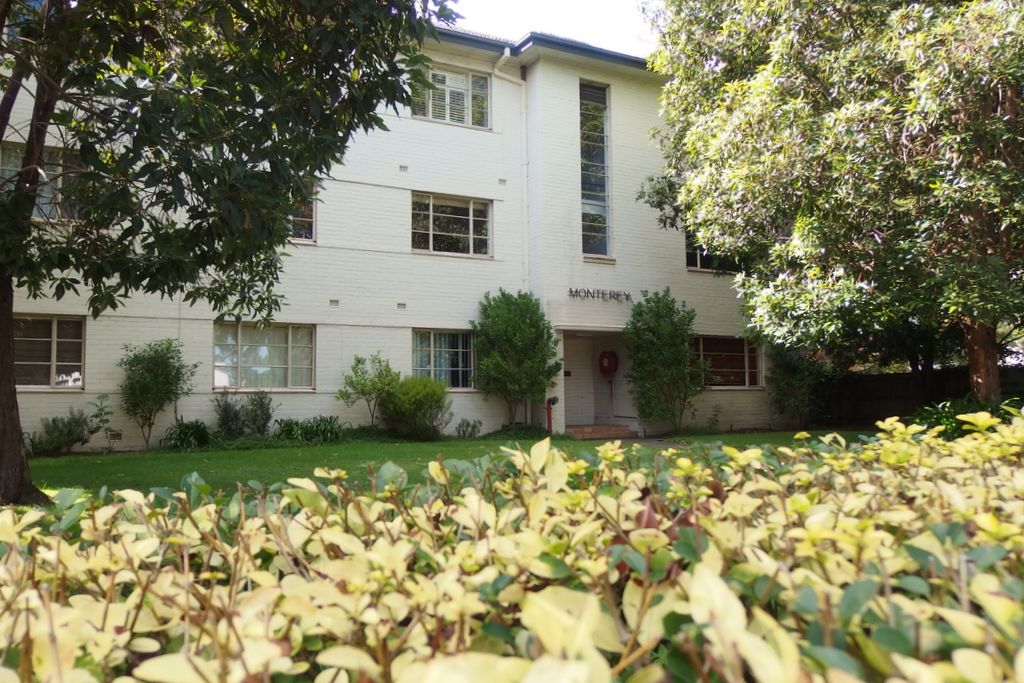 We come first to Monterey Flats, which was occupied by FRUMEL in 1942-1945 and is still standing.
These flats are at the south-east corner of Queens Rd and Arthur St. They had not long been built when they were taken over to house naval codebreaking operations from 1942. Many internal walls were knocked down and the place was described as a rabbit warren.
The codebreaking units based here were the Special Intelligence Bureau, a Royal Australian Navy unit headed by Commander Eric Nave [21], and FRUMEL, headed by Lieutenant Rudolph Fabian. Nave had been breaking Japanese naval codes since the 1920s. Unfortunately, he and Fabian had a difficult relationship, and Fabian was reluctant to share information with allied units [21,22]. FRUMEL eventually took over the Signals Intelligence Branch. Nave left FRUMEL in October 1942, and joined Central Bureau (which had moved to Brisbane by then) in January 1943.
The encoded communications which were decoded here were collected at other sites, including one in Moorabbin from which they were brought here by motorcycle every two hours.
You now make your way to Domain Interchange. Turn into Arthur Street and
walk along it to St Kilda Road.
Walk, or catch any tram in the same direction you were going before,
towards the city. This journey will take about ten minutes on foot
or three minutes by tram.
(More of the St Kilda Road sites can be seen on the way:
see Item 3 above.)
The tram will proceed
straight ahead for a while, but as soon as it bends to the left,
get off, at Stop 20 (Domain Interchange, at
the intersection with Domain Road on the right
and Albert Road on the left).
Get to the other (east) side of the Domain Interchange tram stop.
To go straight to Melbourne Observatory:
You need to cross St Kilda Road towards the Shrine, then
look for the long path towards the Shrine. (The path
starts to the left of the MacRobertson Fountain.)
When you get near the Shrine, you can go around it to the right,
but a better view is obtained by walking to the west side of the shrine,
climbing the steps to its west wall, then turning right, walking around the
shrine by its south side; as you reach its south-east corner you will
be treated to an excellent view eastwards to the Observatory.
Whichever way you go round the Shrine, you will
reach Birdwood Avenue. Cross it at the zebra crossing to reach
the grounds of Melbourne Observatory.
Depending on the time, you may like to have lunch here,
at Jardin Tan restaurant in the Visitor Centre
(the modern glassy building) or its kiosk out the front.
Read about the Observatory at Item 6 below.
To visit the next former codebreaking site:
Catch a No. 8 tram, from Domain Interchange, away from the city.
It will turn left into Domain Road. (No other tram will.)
On your way along Domain Road, look out for 123 Domain Road, on the
south-east corner with Hope Street, and note it as you pass
(see below).
Stay on the tram
until the Park Street traffic lights (stop 24), and get off there.
Continue walking in the same direction (east) along Domain Road, going straight
ahead at a roundabout, until you reach 225 Domain Road, now a block of flats
but formerly the site of the Central Bureau codebreaking unit.
Central Bureau was located at 225 Domain Road, South Yarra, in a large old ivy-clad house called `Cranleigh', from April 1942, but was not here for long: it moved to Brisbane in July 1942. For a picture of it, see http://www.awm.gov.au/collection/100838/ .
One of the Assistant Directors of Central Bureau was Abraham Sinkov, a mathematician with a PhD (George Washington University) who had been employed by the famous American cryptographer, William Friedman, in the US's Special Intelligence Service. He later wrote an excellent introductory book, Elementary Cryptanalysis [25].
`Cranleigh' appears to be named after a village in Surrey, U.K. The village was the home of Robert Ellery, founder of Williamstown Observatory (1853), then Melbourne Observatory (1863, see below), and first Government Astronomer for Victoria. Robert and his brother Sidney migrated to Melbourne and one of them presumably named this house. Incidentally, John Monash (later General Sir John Monash) did some work on `Cranleigh' in late 1911 ( http://www.aholgate.com/mainpages/list_bldgs.html ).
Unfortunately, `Cranleigh' is no longer standing. The site is now occupied by a block of flats.
On your way up Domain Road, you may care to notice 123 Domain Rd (on corner with Hope St) which was the home of
another astronomer, Georg Neumayer (founder of Flagstaff Observatory, 1858), 1861-1863. This is the original house.
The nature of the work done by Central Bureau and FRUMEL was generally different to the famous cryptanalytic work done at Bletchley Park. In cryptology, there is a distinction between codes and cyphers. In a code, the message is broken down into units with some linguistic meaning, such as syllables, words and phrases, and then each of these units is replaced by a codegroup (a short string of letters and/or digits). In a cypher, the message is viewed as a sequence of letters, or digits, or bits, without regard to their meaning, and this sequence is transformed somehow in order to conceal the message. Most of the work done by Central Bureau and FRUMEL was the breaking of codes rather than cyphers.
Throughout its history, cryptology has made use of computational tools and techniques, because of the computationally intensive methods used in cryptanalysis. At times, cryptology has driven the development of computers, most notably during the Second World War through the development of the Colossus cryptanalytic computer at Bletchley Park.
Equipment used at FRUMEL included punch-card tabulating machines. These were not general-purpose computers, but could do certain specific information processing tasks such as tallying information from cards and sorting the cards. Such machines were invented by Herman Hollerith to meet the data processing needs of the US census in 1890.
For further information, see [13] for FRUMEL,
[12] for Central Bureau, and
[21,22] for both.
Now retrace your steps, west along Domain Road, catching the No. 8 tram from
stop 24 (in Park Street, at the traffic lights) going towards the city
(and in the opposite direction
to the way you came). Get off at the Domain Interchange (stop 20), then follow
the instructions given above to go to Melbourne Observatory. (Stop 21 would
normally get you slightly closer, but at the time of writing the walk from
there to the Observatory is blocked by building works. Stop 22 remains a good
option.)
6. Melbourne Observatory: Melbourne's first computer room
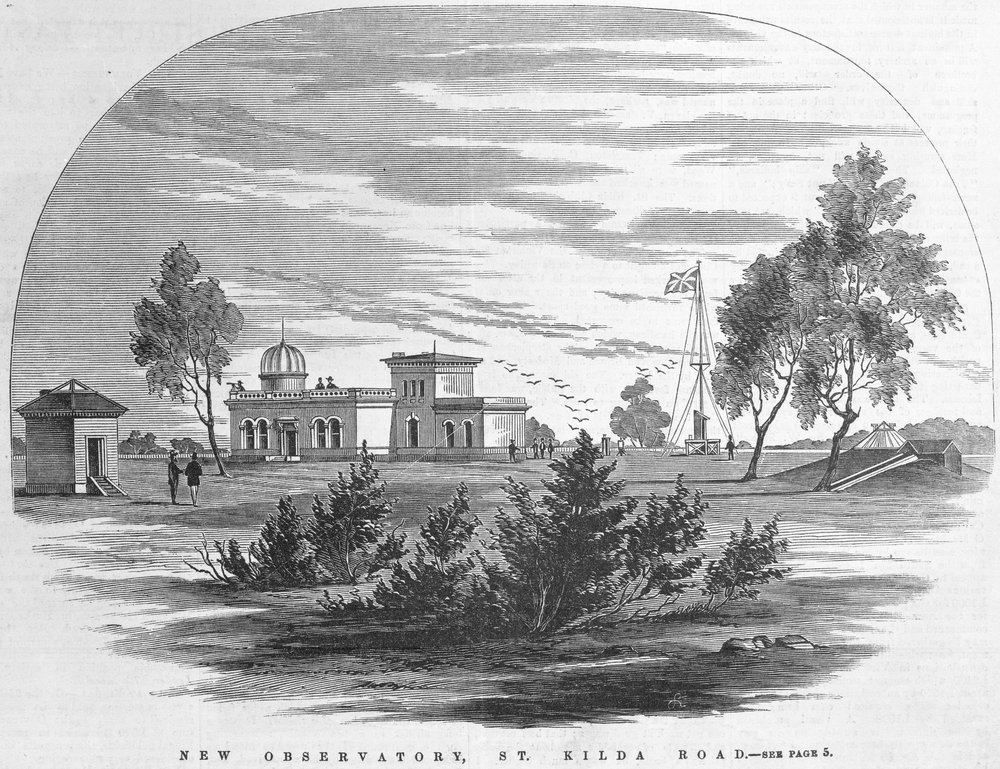 Melbourne Observatory is in Birdwood Avenue, across the road from
the Shrine of Remembrance. It was established on this site in 1863,
through a merger of Williamstown Observatory (est. 1853)
and Flagstaff Observatory (1858, in what is now Flagstaff Gardens, where
it is remembered by a plaque), and celebrated its 150th anniversary in 2013.
Melbourne Observatory is in Birdwood Avenue, across the road from
the Shrine of Remembrance. It was established on this site in 1863,
through a merger of Williamstown Observatory (est. 1853)
and Flagstaff Observatory (1858, in what is now Flagstaff Gardens, where
it is remembered by a plaque), and celebrated its 150th anniversary in 2013.
One room of the main building was the Computer
Room, but this did not house any computing machines. The computers
were people, whose task it was to do astronomical calculations
and to make measurements from photographs
of parts of the night sky.
These computers were required to be unmarried women.
To find the Computer Room, first find the main white
building, with the
grand-looking entrance, which is at the end of the main driveway (left branch),
just before the car park. This was the first building on the
site, in 1863. Moving to the right of the entrance, you find
a pair of windows, then a corner, then (further back from the driveway)
another window, on its own (with a small second storey above it).
You can look through this window
into Melbourne's first computer room, built in 1863, where some
of these human computers worked. Another computer room was
built later, on the other side of the building.
 The photographs measured by the computers were
taken by the astrograph, a telescope
designed for astronomical photography. This was housed
in the Astrograph House (1889) which is the free-standing
building with the dome and with square floor shape.
The photographic plates from the astrograph were developed
in a darkroom in the ground floor of the Astrograph House.
This photographic work was part of an international project,
known by the name Carte du Ciel,
to compile a photographic atlas of the entire sky.
Melbourne Observatory's allocated portion of the sky
was the most southern region.
The photographs measured by the computers were
taken by the astrograph, a telescope
designed for astronomical photography. This was housed
in the Astrograph House (1889) which is the free-standing
building with the dome and with square floor shape.
The photographic plates from the astrograph were developed
in a darkroom in the ground floor of the Astrograph House.
This photographic work was part of an international project,
known by the name Carte du Ciel,
to compile a photographic atlas of the entire sky.
Melbourne Observatory's allocated portion of the sky
was the most southern region.
Melbourne Observatory became part of the Royal Botanic Gardens
in 1997.
Information on public Night Sky Tours at the Observatory may be found at
the RBG current events website.
To next stop:
Cross Birdwood Avenue at the zebra crossing and walk towards the
Shrine, going around it to the right. You will find yourself in
the parade ground at the front of the Shrine. Enjoy the view
northwards along St Kilda Road towards the city.
You may notice the spire of St Paul's Cathedral which we will be visiting later.
Now walk across the grass, bearing to the right (north-west)
towards the main road below (St Kilda Road)
until you reach it. Look for a pedestrian crossing: there should
be one at a tram safety zone nearby. Cross St Kilda Road. You should
be near the south entrance to Victoria Barracks. Walk north (towards
the city) until you come to the north entrance.
7. Victoria Barracks: Australia's first supercomputer
The Defence Signals Directorate (DSD) moved to Victoria Barracks in 1979.
Some general historical information on its time there is at
http://www.asd.gov.au/about/history.htm .
It acquired Australia's first supercomputer from Cray Research in 1986.
The Cray Supercomputer was housed in
the large concrete and glass building you can see down the driveway
and on its left.
Much earlier, the Victoria Barracks housed Australia's
naval codebreaking unit, headed by Commander Eric Nave,
until it moved to Monterey Flats in early 1942.
Please note that you are not allowed to take photographs of
Victoria Barracks.
To next stop:
Walk towards the city. You will find a tram stop in a few minutes.
Catch any tram, towards the city.
Get off at Flinders Street Station. You will see
St Paul's Cathedral at this intersection, at the north-east corner.
(If you prefer, you can walk all the way from the Barracks to the
Cathedral. This should take about 15 minutes.)
CITY CENTRE
8. St Paul's Cathedral: the Babbage connection
St Paul's Cathedral
is at the corner of Swanston and Flinder Streets,
diagonally opposite Flinders Street station, at the very centre of
Melbourne. Its foundation stone was laid in 1880, it was consecrated
in 1891, and its spires were built from 1926. The curious connection
with computing is that, on the east wall of the Macartney Chapel
(to the front right as you
walk down the aisle towards the altar),
on a list of Deans of Melbourne,
can be found the name "Stuart Barton Babbage" of the Dean for the period
1953-1962. This man
was a great-great-grandson of the originator of
the very concept of the computer.
Charles Babbage was a nineteenth century computer pioneer,
before computers even existed. He designed
mechanical computers that were intended to be
powered by steam. The first one, the Difference
Engine, was a special-purpose computer that was partly built.
The second, the Analytical Engine, was
essentially a general-purpose programmable computer,
making Babbage the real originator of the concept of the
computer; however, it was never built.
In the end, he was too far ahead of
his time. The project was beset by political and financial difficulties.
A biography and overview of his work is at
http://www-groups.dcs.st-and.ac.uk/~history/Mathematicians/Babbage.html .
A working Difference Engine No. 2
was constructed by the
Science Museum in London,
and completed in 2002.
Another, identical one
was completed in 2008 and is now at the
Computer History Museum
in Mountain View, California.
A remarkable
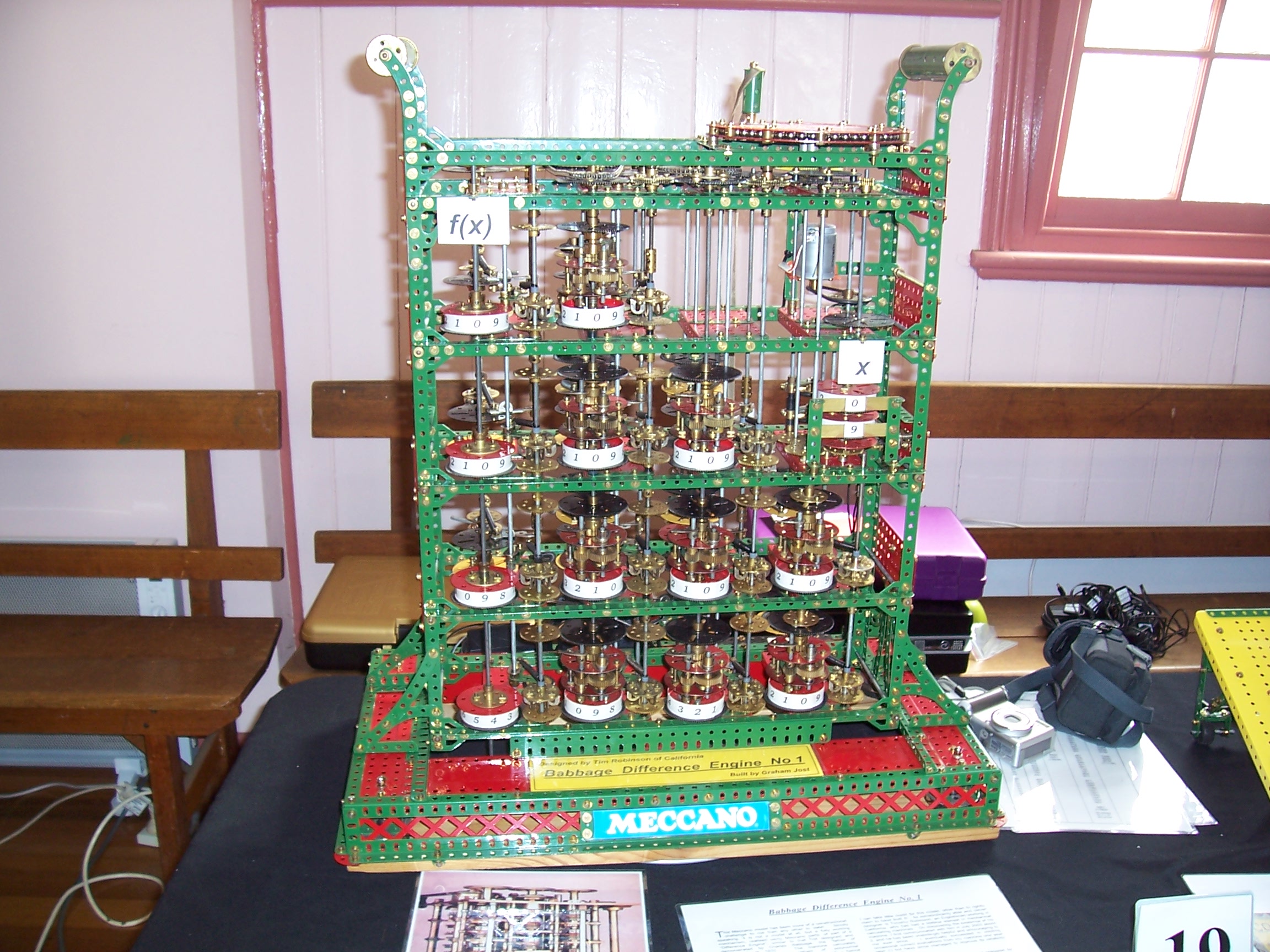
Meccano Difference Engine No. 1 was constructed by Graham Jost
(based mainly on a design by Timothy Robinson)
and displayed at an exhibition at Monash University in 2004.
A
Lego Difference Engine No. 1, following Babbage's design on
a smaller scale, was constructed by Andrew Carol.
 Charles Babbage had a son, Benjamin Herschel Babbage
(known as Herschel), the name Herschel coming from the
astronomer John Herschel who was a colleague of Babbage's
and friend from their Cambridge days. Herschel Babbage
migrated to South Australia in the 1850s, eventually became
a Surveyor-General, and had two sons. One of these,
Charles Whitmore Babbage,
went to jail and did 10 years hard labour
for embezzlement. He speculated disastrously on the stock exchange.
After his release, he moved to New Zealand. He had a son
ten years after the others, this gap probably linked to the
prison term. That son was Stuart's father. Stuart was born
in New Zealand but moved to Sydney.
Charles Babbage had a son, Benjamin Herschel Babbage
(known as Herschel), the name Herschel coming from the
astronomer John Herschel who was a colleague of Babbage's
and friend from their Cambridge days. Herschel Babbage
migrated to South Australia in the 1850s, eventually became
a Surveyor-General, and had two sons. One of these,
Charles Whitmore Babbage,
went to jail and did 10 years hard labour
for embezzlement. He speculated disastrously on the stock exchange.
After his release, he moved to New Zealand. He had a son
ten years after the others, this gap probably linked to the
prison term. That son was Stuart's father. Stuart was born
in New Zealand but moved to Sydney.
Some time after his time at St Paul's, Stuart Babbage served as
Master of New College, University of NSW, 1973-1983: see
an obituary at the New College website.
While visiting the Cathedral, you may like to take the
Ten-Minute Tour, described on a leaflet available near where
you entered.
An app for visitors can be obtained
here.
You have a choice of routes through the city centre.
To State Library of Victoria (a shorter option):
Go to the nearby Swanston Street tram stop (next to Flinders Street Station),
and get on the side nearest the station. Catch any tram north (continuing in
the same direction in which you were travelling previously). Get off
at the first stop after Lonsdale St. The State Library faces Swanston Street,
on its east side,
between Little Lonsdale Street and La Trobe Street. Read about it at
Item 12.
To Bureau of Meteorology:
Go to the nearby Swanston Street tram stop (next to Flinders Street Station),
and get on the side nearest the station. Catch any tram north (continuing in
the same direction in which you were travelling previously). Get off
at the first stop after Bourke St. Walk north along Swanston Street
to Lonsdale Street, then turn right into Lonsdale Street.
Walk along Lonsdale Street for one block, continue across Russell Street,
then after a short distance you will find 150 Lonsdale Street, a tall building
on the north side of the road.
Read about it at Item 14.
For other routes through city centre:
Continue up Swanston Street in the same
direction, either on foot or on any tram (from the stop where you
got off), until you get to Collins St (the next main road),
where you need to catch another tram. At this intersection, note
the Melbourne Town Hall and the beautiful Manchester Unity Building.
Then ...
For west route, with sites about Smalltalk-80, telegraph,
and networks:
catch any tram along Collins St
to the west (i.e., to the left, away from the Town Hall).
Get off at William Street (Stop 3). On the left you should find
a building site. The National Mutual Centre used to be there,
but it was demolished in 2015.
Read about it at Item 9.
For east tour (another shorter option),
go to ICI House as follows:
catch a tram east along Collins St.
Go a few city
blocks, until you reach Spring Street. At this point you have
some options.
(a) For minimum walking, get off the tram, and get on a tram
that goes north up Spring St. This will bend to the right up Nicholson
Street. Then get off, at Albert St (Stop 10).
(b) For maximum walking, get off the tram and walk the route
described in (a).
As you do (a) or (b), note the Windsor Hotel on your left and
Parliament House on your right.
(c) Another option with some walking is to
stay on the Collins St tram as it crosses
Spring St and becomes Macarthur St. Get off just after it crosses
Albert St (Stop 11). Note St Patrick's Cathedral.
On the opposite corner to St Patrick's, you will see a large mural,
which is worth a look before you move on.
This is on the south-facing side of the Melbourne Fire Brigade building,
and is probably best viewed from the other side of the road.
It is `The Legend of Fire' by Harold Freedman, dated 1980-81.
The lower left part depicts human applications of fire and, more generally,
energy, including a picture of a computer, and also an old telephone.
Your next direction is to your left (as you face the mural).
Walk along Albert St to the
Nicholson St intersection.
Go to ICI House.
Alternatively, you can catch a train from nearby Flinders Street Station
to Spotswood, or a ferry from Southbank,
to visit Scienceworks, in the inner West of Melbourne,
to see CSIRAC on display there.
9. Site of National Mutual: Smalltalk-80's Australian debut
 For about two decades until 1991, the insurance company
National Mutual had a very
active Operations Research Department. Over time it developed
an emphasis on the application of computer science
as a tool for the solution of business problems. For example, it
created some new special-purpose languages which gave many staff the ability
to do complex insurance computations which had previously been
done only by specialists. One innovation the OR Department pioneered within
the organisation was the use of Object-Oriented Programming,
which it introduced to NM in 1985. This appears to be the
first commercial use of OOP in Australia.
In 1987 the Department became the first users in Australia
of Smalltalk-80 (buying a licence from ParcPlace),
which among all OO languages was arguably the purest, most powerful
and most historically influential, although due in part to its price
it never became popular. The OR Department promoted OOP in the
local IT community and helped to stimulate its introduction to
tertiary courses. Three members of the Department ran the first
public OO course in Australia in 1988. The Department of Software
Development (later merged with other departments into the School of
Computer Science and Software Engineering), at the Caulfield
campus of Monash University,
was one of the first University departments to take
up this technology and promote it strongly in undergraduate curricula.
For about two decades until 1991, the insurance company
National Mutual had a very
active Operations Research Department. Over time it developed
an emphasis on the application of computer science
as a tool for the solution of business problems. For example, it
created some new special-purpose languages which gave many staff the ability
to do complex insurance computations which had previously been
done only by specialists. One innovation the OR Department pioneered within
the organisation was the use of Object-Oriented Programming,
which it introduced to NM in 1985. This appears to be the
first commercial use of OOP in Australia.
In 1987 the Department became the first users in Australia
of Smalltalk-80 (buying a licence from ParcPlace),
which among all OO languages was arguably the purest, most powerful
and most historically influential, although due in part to its price
it never became popular. The OR Department promoted OOP in the
local IT community and helped to stimulate its introduction to
tertiary courses. Three members of the Department ran the first
public OO course in Australia in 1988. The Department of Software
Development (later merged with other departments into the School of
Computer Science and Software Engineering), at the Caulfield
campus of Monash University,
was one of the first University departments to take
up this technology and promote it strongly in undergraduate curricula.
The building, then known as the National Mutual Centre,
was built in the 1960s and demolished in 2015.
The picture shows it in 2008, when it was named after Suncorp.
The plaza includes a statue of John Batman,
often described as the founder of Melbourne, but
it may not be accessible due to building works.
Go to the nearby intersection of Collins St and William St,
cross Collins St and go north along the east side of William St
until you reach Little Bourke St. The next site is at the
intersection of William St and Little Bourke St.
(This is a short walk, less than 5 mins. Instead, you can catch a tram
up William St, get off at either Bourke St or
Lonsdale St, and then walk the short distance along William St
to Little Bourke St.)
10. Site of Australia's first telegraph
At the North-East corner of William St and Little Bourke St,
just to the right of an entrance to the Supreme Court
building, you will find a plaque. It has a picture of a
Morse Code key at the top, and the text reads:
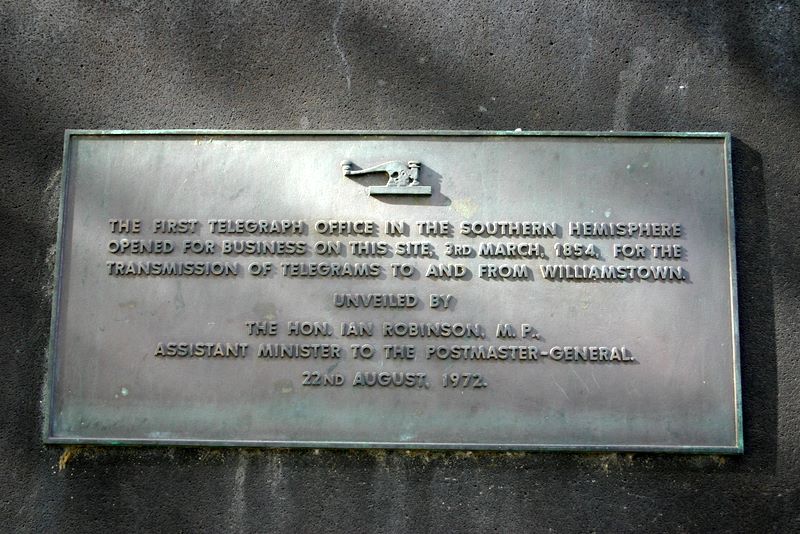
The first telegraph office in the southern hemisphere
opened for business on this site, 3rd March, 1854, for the
transmission of telegrams to and from Williamstown.
Unveiled by
The Hon. Ian Robinson, M.P.,
Assistant Minister to the Postmaster-General.
22nd August, 1972.
An electrical telegraph sends messages coded as electrical signals over
a wire, and a telegram is a message so sent. Electrical telegraphy
began in the early 19th century.
The Melbourne-Willamstown telegraph line
was constructed by Samuel McGowan, who was
born in Ireland and educated in Canada where he was taught by
Samuel Morse, after whom Morse code is named.
Later in 1854, the line was extended to Geelong.
Although communication and computation
have been regarded as separate subjects for much of their history,
they have converged in recent decades and are now seen as closely related
parts of the same broad discipline.
To next stop:
Go north along William St, past the front of the Supreme Court
Building, to Lonsdale St. You will be turning right here, but
for better views, cross Lonsdale St first and then turn right, walking
along the north side of the street. Around the middle of this block,
on the south side of the road, is the next site.
11. Lonsdale Exchange
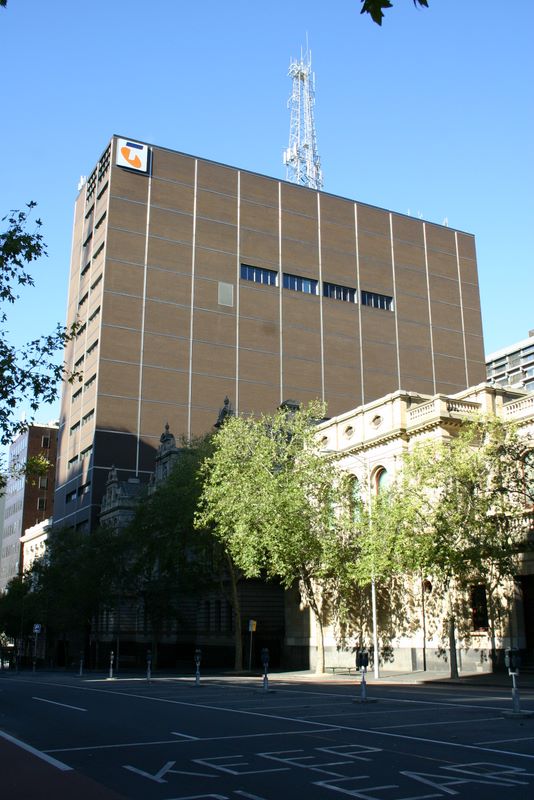 The top floor of the Lonsdale Exchange, at 447 Lonsdale St, was home to some of
Melbourne's earliest uses of packet switching and to a precursor of
modern email.
The top floor of the Lonsdale Exchange, at 447 Lonsdale St, was home to some of
Melbourne's earliest uses of packet switching and to a precursor of
modern email.
In 1970, the Postmaster-General's Department (ancestor of Telstra)
started building its Common User Data Network (CUDN).
Its first site was at
the Haymarket Exchange in Sydney that year, and the Lonsdale Exchange site
was installed in 1972. CUDN used packet
switching, in which data is divided into "packets" which are
then routed independently through the network and reassembled at their
destination.
In those days, packet switching was a relatively new technology.
In earlier networks (e.g., Telex), information was
routed by circuit switching, in which the route for the entire
message is determined --- and all the required electrical connections
switched into place --- before sending it.
Packet switching is now the standard for transmitting information
over the internet. The CUDN
could send messages using the store-and-forward technique,
in which information is stored on disk at each intermediate node and
later forwarded on, possibly to another intermediate node,
on the way to its destination. The sender and receiver could
both be at a terminal (i.e., a device normally used by a computer
to read or display data, but here connected to the CUDN).
This messaging facility may be regarded as a precursor of email.
The CUDN also has a faster method for shorter, more urgent messages,
but with no guarantee of delivery. This was similar to the
Internet Protocol (IP) on which the Internet is based.
CUDN was the first commercial packet-switched network in Melbourne,
though its services were only available to large organisations.
It was not quite the first packet-switched network of any kind here,
since from about 1971
the Civil Aviation Authority had a local node of a worldwide
network run by the Société Internationale de
Télécommunications Aéronautiques
(SITA). In fact the messaging facility of CUDN was based on that
of the SITA network, and both were built by Univac (later Unisys).
The CUDN did not realise its full potential, due to long delays
in constructing its software.
You probably will not need to spend long admiring the architecture
of the Lonsdale Exchange. The appearance of its west side has been
likened to Ned Kelly.
To State Library of Victoria:
Continue walking east along Lonsdale St, to Swanston St.
Cross Swanston St at the lights there, then turn left and
walk north up Swanston St until you come to the State Library
of Victoria on your right, set back from the street and with a
square in front.
Read about it at Item 12.
Alternatively, from Lonsdale Exchange, walk east to the next
intersection, with Queen St. Turn left there, and walk north
to La Trobe St. Catch any tram eastwards, and get off at
Swanston St, where you will see the State Library and the square
in front of it.
To former Bureau of Meteorology site:
Continue walking east along Lonsdale St, for 10-15 minutes,
to just beyond Russell St. You'll see 150 Lonsdale Street on the north
side of the road, a little east of Russell Street.
Read about it at Item 14.
To sites near University of Melbourne,
beginning with MONIAC:
Continue walking east along Lonsdale St, to Elizabeth St.
You should find a tram stop nearby in Elizabeth St
(on south side of Lonsdale St). This is Stop 5.
You have three options, listed in order of increasing amount of walking:
- Catch tram 19 or 59 northwards. Get off at Stop 9, where Elizabeth St
meets a huge and complicated roundabout. Cross to the east side of the
road, find Pelham St, and walk east along it to Barry St. Turn left at
Barry St, and walk a short distance north to the entrance of the
Faculty of Business and Economics (FBE) building. Here you will find the
Giblin Eunson Library, which houses MONIAC.
- [very short tram ride, then 10 minute walk] Catch tram 57, get off at Stop 7 (Victoria St), and cross to the
diagonally opposite (i.e., north-east) corner of the intersection of
Elizabeth St and Victoria St. Nearby (eastwards) is the intersection of
Victoria St and Leicester St. Walk north along Leicester St, staying on its
west side. Keep walking north across Queensberry St but turn left almost
immediately afterwards into Barry St, which heads diagonally (north-west).
Keep walking along Barry St as it crosses Pelham St, but almost immediately
afterwards you find the FBE building on your left, with the Giblin Eunson
Library within it.
- [20 minute walk] Walk north along Elizabeth St, crossing to the other (east) side of
the road at some point. After crossing Victoria St, turn immediately right
along Victoria St, and then immediately left into Leicester St, staying on the
west side of the latter. Walk north along Leicester St, staying on its
west side. Keep walking north across Queensberry St but turn left almost
immediately afterwards into Barry St, which heads diagonally (north-west).
Keep walking along Barry St as it crosses Pelham St, but almost immediately
afterwards you find the FBE building on your left, with the Giblin Eunson
Library within it.
Go to MONIAC.
12. State Library of Victoria: Vicnet and Pictoria
 Libraries are about collecting, storing, maintaining and providing access
to information. Traditionally this information was in printed form, but
electronic representations of information now play a huge part in the
activities and services of most libraries. Public libraries have a vital
role in maximising community participation in our `Information Age'.
Libraries are about collecting, storing, maintaining and providing access
to information. Traditionally this information was in printed form, but
electronic representations of information now play a huge part in the
activities and services of most libraries. Public libraries have a vital
role in maximising community participation in our `Information Age'.
The State Library of Victoria
(SLV) was founded in 1854 and opened in 1856.
This was during the chaotic times of the gold-rush, and it was expected
that such an institution would help to strengthen and improve society.
We mention two of the State Library's innovations in using computers
to improve information access.
Vicnet was a pioneering initiative to provide internet access for community
organisations, starting at SLV in 1994.
This worked in two directions: such groups could
access information on the internet, and also make information of
their own available to the internet through Vicnet. Providing this latter
capability was a significant new step for libraries, and was important
in trying to bridge the "digital divide" [24].
Vicnet was launched in May 1995 by the Premier of Victoria, Jeff Kennett.
It became one of Australia's first
Internet Service Providers.
Its website was once one of the top ten in Australia, and
it hosted the first online edition of
The Age [15].
Vicnet connected every library in Victoria
to the internet, provided relevant training to community
organisations, led the country in providing multilingual internet access,
and provided computer access to the visually impaired.
It is recognised as one of the first and most influential
community networks --- i.e., networks of computers supporting
community organisations --- in the world.
It also set up a social networking site, My Connected Communities,
in 2001 (following a pilot project in 2000).
The idea for Vicnet
originated with Gary Hardy (its first General Manager), then at RMIT Library,
and was strongly supported by Don Schauder, then RMIT Librarian,
and Derek Whitehead, Deputy State Librarian from 1995, and whose
responsibilities included Vicnet.
For more information on the history of Vicnet,
see [15, 24].
Pictoria was an SLV project to capture electronically
its large collection of historical pictures, beginning in 1989.
Initially, pictures were copied onto a videodisc, which was then digitised
in 1994 and made available over the web from 1996.
The SLV was the first library in Australia and
one of the first in the world to do this.
The process of digitising images and making
them more accessible online continues at SLV
(though the name Pictoria is no longer used) and
has been a core task there since the mid-1990s.
The original Pictoria project produced over 104,000 digitised
pictures. Many more have been added since, and the work has
expanded to include pamphlets and maps.
Now, around 310,000 digitised items are available through the
library's
Main Catalogue.
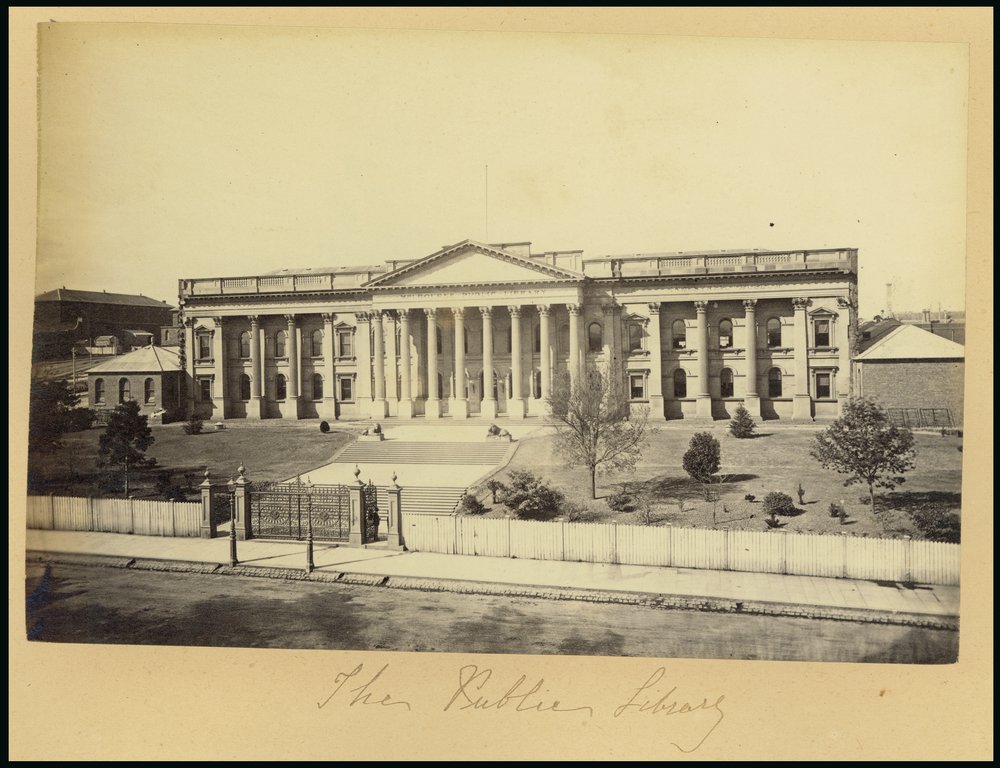
The famous Domed Reading Room --- now the La Trobe Reading Room --- was
opened in 1913, and now houses the Australiana collection.
When visiting, it is worth comparing the more traditional impression
of a library given here, with the modern Trescowthick
Information Centre directly below.
The next site, Storey Hall at RMIT, is a very short walk north (away from
the Library and the City Centre) along Swanston Street, away from
the intersection with La Trobe Street.
To go straight to the sites near University of Melbourne,
beginning with MONIAC:
You have a tram-then-walk option, or an all-walking (20 mins) option.
- Catch any tram northwards along Swanston St, getting on at nearby Stop 8
and getting off at Stop 3 next to Lincoln Square.
- Alternatively, walk north along Swanston St, staying on its left (west)
side, until you reach Lincoln Square, and go about halfway along the east
side of Lincoln Square.
Now walk west across Lincoln
Square to the west section of Pelham St, then walk west along Pelham St,
getting onto its north side at some stage. Keep going until
you pass University Square on your right and reach Barry St. Cross Barry St,
turn right into it, and you will almost immediately find yourself at the
entrance to the FBE building.
Go to MONIAC.
To go straight to the University of Melbourne sites,
bypassing MONIAC:
Catch any tram northwards along Swanston St, getting on at nearby Stop 8
and getting off at Stop 1 next to the Richard Berry building at the
University of Melbourne.
Alternatively, walk north along Swanston St, staying on its left (west)
side, until you reach the Richard Berry building at the University of
Melbourne, which is next to Monash Rd and opposite Faraday St.
Go to the site of Australia's first internet
connection.
13. RMIT's first computer, and the arrival of ALGOL 60
 The Royal Melbourne Institute of Technology (RMIT) bought its first computer in 1962, and it was commissioned in March 1963. It was an NCR-Elliott 803B, ran at 1,500 operations per second, and had 8,192 words of memory, each 40 bits long (including one as a check on the others) [18]. Its memory was "ferrite core", which stores each bit in a tiny magnetic ring of ferrite (a ceramic material based on iron oxides) with wires passing through it.
An important feature of the Elliott 803B (in fact, one of the main factors leading to its selection) was that you could program it using the language ALGOL 60. This language, whose name stands for ALGOrithmic Language, was introduced in 1960 in order to reduce the gap between algorithms (which describe computer procedures at a high level) and the more low-level instructions executed by the computer's hardware. It became very influential in the development of programming languages and was widely used to teach programming, although it did not get much commercial use. The ALGOL 60 compiler for this computer was written by C.A.R. Hoare (also the inventor of the QuickSort algorithm), when working for the Elliott company. RMIT offered one of the first computer science courses in Australia, starting in 1964, and students came there from the University of Melbourne to learn ALGOL 60. The computer was run by the Department of Mathematics, and was eventually replaced by an ICL 450.
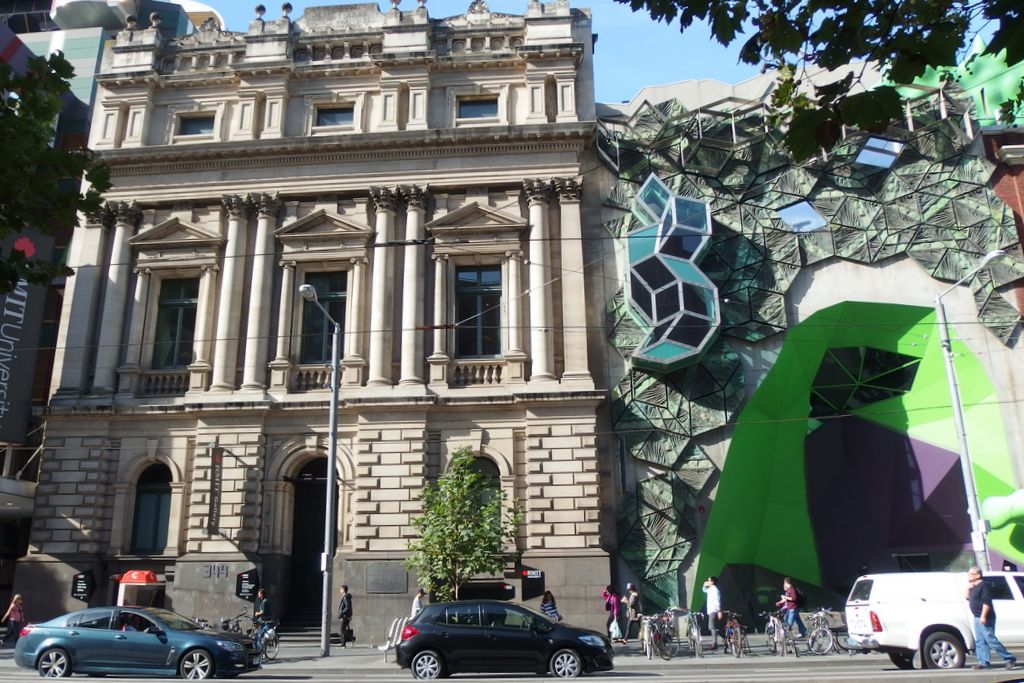
The Elliott 803B was located in Storey Hall (342 Swanston St), a 19th century building that now houses the RMIT Gallery. It was behind the window to the right of the main entrance (as seen when you face the building). (To ensure that you are looking at the right window, note that its arch is level with the arch of the main entrance, and the window currently sits above a cafe entrance. It is the window behind the small tree in our picture.) If the gallery is open when you visit, you can go in (turn right immediately after entering) and see the room, although there is no trace of the computer now.
The window at the same level to the left of the main entrance belonged to the office of Elliott Computing Services.
For further information, see [18].
You can read more about the building itself at http://www.rmit.edu.au/about/heritage/bld16 . The new wing on its right, completely different in style, is also worth a look. It includes fragments of a non-periodic tiling of the plane, and is a feature of the Mathematics Tour of Melbourne [27].
To go to the sites near University of Melbourne,
beginning with either MONIAC or the
site of Australia's first internet connection:
Follow the directions at the end of the section on the State Library
of Victoria, above.
To go to the Exhibition Building and Melbourne Museum:
(a) For minimum walking (but it may actually take more time):
Catch any tram east along La Trobe St, and get off at Stop 10.
Then catch tram 95 or 96 north along Nicholson St, and get off
at Stop 12 or 13. Melbourne Musem is the modern building north
of the old Exhibition Building.
(b) For medium walking (5-10 mins):
Catch any tram eastwards along La Trobe St, and get off at Stop 8
(Exhibition St).
Then walk north up Rathdowne St, and enjoy the sight of the
Exhibition Building on your right. Past it on your right is
the Melbourne Museum, a great architectural contrast and easily
identified by its long sloping outdoor roofs outside the main
entrance.
(c) For maximum walking (10-15 mins):
Walk along La Trobe St to Exhibition St, then turn left and go
up Rathdowne St and follow the directions given in (b) above.
Go to Exhibition Building.
To ICI House:
Catch any tram eastwards along La Trobe St, and get off at Stop 10.
Then walk south along Nicholson St to its intersection with
Albert St. As you do so, you'll see ICI House on your left.
Read about it at ICI House.
To Bureau of Meteorology:
Walk back to the corner of Swanston and La Trobe Streets. Turn left
and walk east along La Trobe Street for one city block, to the
intersection with Russell Street. (You could also do this by any east-going
tram along La Trobe Street, getting off at the stop after you get on.)
Then turn right and walk south along Russell Street for one city block,
until the intersection with Lonsdale Street. Then turn left and walk a little
way along Lonsdale Street until you come to 150 Lonsdale Street.
Read about it at the Bureau of Meteorology.
14. Bureau of Meteorology: computing the weather
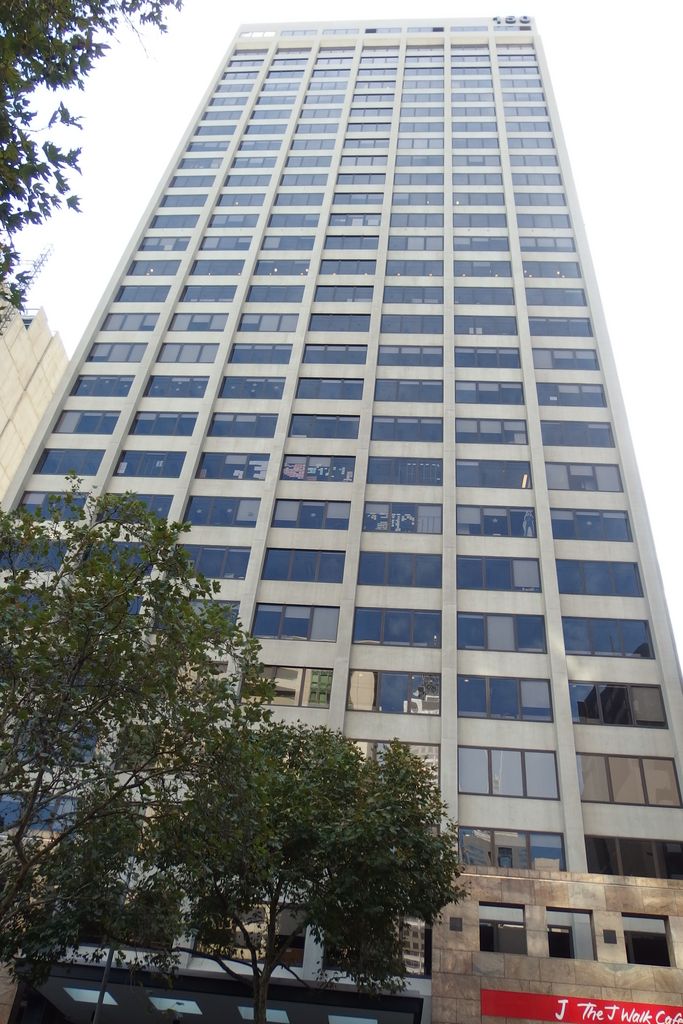 150 Lonsdale Street once housed the Head Office of the Bureau of Meteorology and several of its most powerful computers. A short walk to the east, at the north-east corner of Lonsdale St and Exhibition St (at what was then 254 Exhibition St), was the World Meteorological Centre (WMC), though that building no longer exists.
In the 19th century, weather forecasting was done by separate authorities in each of the Australian colonies (now states), often through their astronomical observatories. Melbourne was a case in point, with Melbourne Observatory taking on meteorological functions alongside astronomy.
In 1908, the Bureau of Meteorology began, under the new federal government, and took over the meteorological functions from the state observatories.
Australia's first computer-based weather forecast was done on CSIRAC in 1956, by Uwe Radok at the University of Melbourne and his MSc student Dick Jenssen. Significant advances on computer-based weather prediction were made at the Bureau in the 1960s, including by Ross Maine (also an MSc student of Radok) using CSIRAC and other machines.
The Bureau's Automatic Data Processing (ADP) section was established in 1963 and initially used external computers. The Bureau's first computer, an IBM 360/65 (the "first and last" IBM 360 in the Southern Hemisphere), was installed in 1968. The motivation for getting this computer was at least threefold. Firstly, automatic weather instruments were generating unprecedented volumes of data that needed to be processed. Secondly, Melbourne was chosen as the site for a World Meteorological Centre, one of three worldwide (the other two being in Washington and Moscow). This reflected its prominence in southern hemisphere meteorology and greatly widened the geographic scope of its work. Thirdly, from 1964, weather satellites produced data on large regions where observational coverage had previously been sparse. The new computer would process the rising tide of data in order to produce more accurate forecasts.
The computer was initially located in the WMC, on the ground floor, visible to passers-by through large windows. It attracted a lot of interest and was, for many people, their first-ever view of a computer.
The Bureau's computers were moved to 150 Lonsdale St in 1974. That building continued to house the Bureau's major computers (including its first supercomputer, an ETA 10P, installed in 1988) until the Head Office moved to the other end of the city centre, in the Docklands area (700 Collins St), in 2004. From the 1990s, Bureau computers were used to assist the work of the Intergovernmental Panel on Climate Change.
For further information see [7,8,9,14].
From 150 Lonsdale Street, walk east along Lonsdale Street to the intersection
with Exhibition Street. There, observe the site of the former World
Meteorological Centre on the north-east corner. That building no longer exists.
To State Library of Victoria:
Go half-a-block
north up Exhibition Street until you reach Little Lonsdale Street.
Turn left, and walk west along Little Lonsdale Street, crossing Russell Street.
As you continue west after Russell Street, you will find the side of the
State Library building on your right. Eventually you will reach the forecourt
of the library, where you can turn right to walk to the library entrance.
Read about it at State Library of Victoria.
To ICI House:
Cross Exhibition Street and continue east along Lonsdale Street for just over
one city block. Cross Spring Street when you reach it. Shortly afterwards,
you reach Nicholson Street. Stop there. On the opposite side of Nicholson
Street is ICI House, now Orica House.
Read about it at ICI House.
To Exhibition Building and Melbourne Museum:
Probably the quickest way to do this is actually to go to ICI House on foot,
as described just above, and then catch a tram
(noting Item 20, the Royal Exhibition
Building, on the way). But if you wish to walk all
the way to Melbourne Museum and to do so as quickly as possible
(which will be about 10-15 minutes), then walk
north up Exhibition Street all the way, being careful to follow it in the
half-right direction at the intersection with La Trobe Street. On the way,
you will cross La Trobe and Victoria Streets. Then keep the Exhibition
Building on your right, and once you pass it, you will see the Museum on
your right. Turn right, and walk between the Exhibition Building and the
Museum until you reach the Museum entrance on your left.
Read about the Exhibition Building at
Item 20.
15. ICI House
ICI House, now Orica House, is a 20-storey office building
at 4 Nicholson Street, East Melbourne.
It was originally the head office of the local arm
of the British company, Imperial
Chemical Industries (ICI). Some of
the calculations done in its design (using pre-computer methods)
were used to check the work of building frame analysis programs
that were run on CSIRAC.
(This is mentioned briefly in a radio interview at
http://www.abc.net.au/7.30/stories/s68879.htm,
although it does not seem that CSIRAC was used
in the design of ICI House itself.)
The building was completed in November 1958 and for
over two years was the tallest building in Australia.
For further information on its history and architecture, see:
https://www.theguardian.com/cities/2016/sep/07/melbourne-australia-first-skyscraper-ici-orica-house ,
http://www.walkingmelbourne.com/building229_ici-house.html ,
http://en.wikipedia.org/wiki/ICI_House .
ICI also made use of computers in their own work.
In 1961, an ICT 555 computer was installed in the 16th floor
of this building. It was lifted up, outside the building,
by a crane, and entered the 16th floor through a window.
On 25 October 1964 it was removed by the same route, in reverse,
and replaced by an IBM 1440 computer.
ICI also bought a Ferranti Sirius for their research facility
in Ascot Vale, in 1962.
Both the ICT 555 and Ferranti Sirius were replaced by an
IBM System 360 after July 1966. The Ferranti Sirius was
given to Monash University in 1967 and was located in the Department
of Chemistry or Chemical Engineering (see above).
To Royal Exhibition Building and Melbourne Museum:
You should be at the corner of Nicholson St and Albert St.
At the tram stop there, catch tram 95 or 96 away from
the city. You will soon see the Exhibition Gardens on
your left, and the large domed Royal Exhibition Building within it.
Get off at Stop 12, and cross to the west side of the road,
to see the east side of the building.
Alternatively, you could walk most or
all of the way to the east side of the Royal Exhibition Building,
through the Exhibition Gardens.
This should take about 10-15 minutes.
NORTH
16. MONIAC, a hydraulic analogue computer for economic modelling
At 111 Barry Street (just south of the University of Melbourne's main campus and fronting onto University Square), you will find an entrance to the FBE Building which houses the university's Faculty of Business and Economics. As you enter, the Giblin Eunson Library is on your right. Enter the library and immediately turn left. There you will find a MONIAC --- MOnetary National Income Analogue Computer.
This is different to all other computers or calculators you meet on this tour, in that it is analogue. The others are digital, in that they represent information using units, or symbols, that can each be in a finite number of distinct states. For example, it might use digits, where each digit must be one of 0,1,2,3,4,5,6,7,8,9, or it might use the on-or-off states of switches instead of digits. By contrast, analogue computers use quantities that can vary in a smooth, continuous way, instead of in discrete steps. Examples of analogue quantities are height, volume, time, temperature, the amount of electric current in a wire, the voltage at a point in a circuit, the angular direction of a rotating wheel, or the flow of water in a pipe. Many physical quantities are analogue in nature, so it is natural to try to develop analogue computers in order to do calculations involving such quantities. Analogue computers are often designed to use physical principles to solve differential equations, and this is the case with MONIAC, which in effect solves a system consisting of nine first-order DEs and one second-order DE.
Early analogue calculators or computers were based on distances and angles in mechanical devices, or (later) electric currents. MONIAC is unusual in that it is based entirely on the flow of water, making it a hydraulic analogue computer. Its purpose is to model the behaviour of a national economy, with water flow representing the flow of money and tanks representing economic entities and sectors. Control is possible at various points, such as by adjusting the openings into pipes. There are mechanical links between some components. The water is coloured so that it is easy to see.
MONIAC was designed and built in the UK in the late 1940s by Bill Phillips (1914-1975), a New Zealander who studied engineering and sociology on his way to becoming an economics student at the London School of Economics (LSE). His engineering knowledge was put to good use on MONIAC, which was able to do economic computations that were not possible on other machines at the time. It was first demonstrated in 1949, and led to Phillips gaining a lecturing position at LSE, where he became a professor within a decade. While other computers soon overtook MONIAC's computational capabilities, it remained a very effective teaching tool for demonstrating macroeconomic concepts (which was, in fact, its originally-intended purpose). The original MONIAC was eventually given to the University of Leeds where it is today.
About 14 MONIACs were built. The only two that are still operational are the one at the Reserve Bank of New Zealand Museum (http://www.rbnzmuseum.govt.nz/activities/moniac/introduction.aspx), which is demonstrated once a month, and one at the University of Cambridge which is demonstrated once a year. This MONIAC, which arrived at the University of Melbourne in 1954, is one of the other dozen or so around the world that are not operational. The Reserve Bank of NZ Museum has a virtual simulator for much of MONIAC; see the above link.
MONIAC was a special purpose computer, able to do specific computations for a specific task but not able to be programmed to solve arbitrary computational tasks. So it does not meet the usual modern definition of the term "computer", and today would be more accurately described as a calculator or simulator.
For further information on MONIAC, see [10].
General information about the Giblin Eunson Library is at http://library.unimelb.edu.au/libraries/bee and opening hours are at http://library.unimelb.edu.au/hours/branches/giblin_eunson_library .
To next stop, Old Physics:
Exit the FBE building onto Barry St, and walk north to Grattan St.
A little to the right (i.e., east), you will see traffic lights outside
the Main Gate (a.k.a. Gate 10) of the University of Melbourne.
Use these lights to cross the road and enter the campus through that gate.
Walk north across Kernot Street, up some stairs and under the John Medley
building (which surrounds your path on the left, right and above).
As you go north you will find South Lawn on your left. Walk west across it
(avoiding the long rectangular pool)
to the Baillieu Library, where you reach Professors' Walk which bounds the
west side of South Lawn. Walk north along Professors' Walk / Bank Lane.
You will pass Old Arts (building number 149), keeping it on your right.
The next building on your right is the one we seek. It should be building
number 143 and might be labelled Biosciences, but used to be part of Old
Physics. You should also find the Babel building (number 139) on your left
(i.e., west of the Old Physics building).
You should be almost level with (i.e., due west of) the south-west
corner of Union House.
(If you reach University House, you've gone too far.)
17. Old Physics, University of Melbourne: CSIRAC's first
Victorian home
When CSIRAC was moved to the University of Melbourne in 1956, it was
housed in the Department of Physics, in a building now known
as Natural Philosophy [19],
next to the Old Physics building and the Professors' Walk.
(The department is now elsewhere on campus.)
CSIRAC's recommissioning was accompanied by the creation of
the organisational unit in which it sat: the Computation
Laboratory, later called the Computation Department, which split
in the late 1960s into the Computer Centre and the Department of
Information Science (renamed to Computer Science in 1976).
CSIRAC was located in a large room in the north-west of the building,
on the ground floor, where air from the one-metre space under the floor
was used to cool the computer.
To either of the next two stops:
Walk east, keeping Union House on your left and the building housing CSIRAC
on your right. After about 100m you'll come to the end of Union House, and
will find yourself at a bend in a road. On your left, the road is Union Road;
straight ahead, the road becomes Masson Road; and on your right is
the multi-storey Raymond Priestley building. Keep walking east along
Masson Road, keeping the Raymond Priestley building on your right.
You will have to do a right-then-left turn at the end of the Raymond Priestley
building, but then you can keep walking east along Masson Road.
When Masson Road reaches Spencer Rd, your route then depends on which site
you are visiting next.
For the Physics Museum:
turn left into Spencer Road and walk
north along it (keeping the Elisabeth Murdoch building on your right)
until you see the School of Physics on your right (north of the
Elisabeth Murdoch building). Enter that building, and follow signs to
the Physics Museum.
Go to the Physics Museum.
For the site of Australia's first internet connection (skipping
the Physics Museum):
do not turn at Spencer St; keep walking straight ahead.
You are still on Masson Rd, although this section of it is closed to vehicles.
Keep the Richard Berry building on your right. It houses the School of
Mathematics and Statistics, and its eastern part used to house Australia's
first internet connection.
Go to the site of Australia's first internet connection.
If you are visiting the sites in a different order, your options include:
To MONIAC:
Walk south (initially keeping Old Physics and the former CSIRAC room on
your left) along Bank Lane / Professors' Walk for 150-200m until you have
the Baillieu Library on your right and the South Lawn on your left. Walk
east across South Lawn to the road that bounds its east side
(avoiding the long rectangular pool by the road).
Looking south along this road, you should see a building which straddles
the road and has part of it going over the road linking its two parts.
This is the John Medley building. Walk south along the road, under the
archway formed by that building, then cross Kernot Rd immediately
afterwards, then exit the campus by the Main Gate (a.k.a. Gate 10).
You are now on Grattan St. Cross it at the traffic lights.
You are facing University Square. Walk a little west until you reach
Barry St, which bounds the west side of University Square. Get onto the
west side of Barry St and walk south along it. Just before the end of
University Square, and just before Pelham St, you will find the Faculty
of Business and Economics (FBE) building on your right. This is the
location of the Giblin Eunson Library, which houses MONIAC.
Go to MONIAC.
18. Physics Museum, University of Melbourne
The Physics Museum,
University of Melbourne has a number of old calculators
in its large collection of old scientific instruments and devices.
It is open on weekdays, 9am-5pm, while the University is open.
It can be found on Level 2, Hercus/Laby Foyer,
of the School of Physics (building 192)
at the corner of Swanston and Elgin Streets.
You can also peruse many of the items online, at
http://victoriancollections.net.au/organisations/university-of-melbourne.
Note that this is the current location of the School of
Physics in the University of Melbourne. However, in the days
of CSIRAC, it was located elsewhere on campus, at Old Physics / Natural
Philosophy, which you may have visited earlier in this tour.
To next stop, the
site of Australia's first internet connection:
Go to Swanston St (the main road on the east side of the School of Physics),
and stay on the same side of the road (the west side).
Walk south (towards the city) for about 100m or a little more, until you find
Faraday St on your left and Monash Road on your right. The building on your
right is the Richard Berry Building, and is the site of Australia's first
internet connection.
Go to the site of Australia's first internet connection.
If you are visiting the sites in a different order, your options include:
To Old Physics:
Go west across the campus towards Union House.
Go around Union House on the left, and walk along its south side, keeping
Union House on your right.
Continue past the end of Union House.
The building just south of the very end of Union House is the one you want,
and you want the north-west corner of it, next to Professors Walk.
This is the Natural Philosophy building
(Melways ref. 571F7, bldg 143).
Go to Old Physics.
19. Site of Australia's first Internet connection
Australia first connected to the Internet on the night of
23 June 1989, through a device in the Richard Berry building
at the University of Melbourne.
This statement needs some background and explanation.
The first computers were standalone machines, working in
isolation from each other. Later, beginning in the 1960s,
they were connected into networks.
Such a network consists of nodes
(the computers themselves) and links
(the wires and cables used to carry data
from one computer to another).
The number and size of these networks grew rapidly in
the 1970s. They operated in many different ways,
depending on the type of equipment used within them.
Communication between these diverse networks also
occurred, for movement of data including email.
But this heterogeneous collection of networks
was not yet the Internet, as we use the
term today.
Networks use protocols to direct their traffic.
These are rules which the devices at the nodes use to
determine what to do with the information
they receive (where to send it next, what format to use, etc).
Until 1983, the protocols used varied across organisations,
regions and countries. Then, the Transmission Control
Protocol (TCP) and Internet Protocol (IP) were introduced in
the US and some other countries. These protocols directed
the addressing, transmission and delivery of data through
the network, and were intended to introduce a new level of
consistency and reliability across the various interconnected
networks around the world. Interaction between computers,
especially those on different networks, became much easier
and less dependent on
the details of the underlying technology.
The term Internet came into use, to describe the
interconnected networks of computers around the world
that used a particular set
of protocols, most notably the TCP and IP.
The result of the broad adoption of these protocols
was very rapid growth in network size, connectivity,
traffic, and applications.
Australia participated in international computer
networking, initially through university Computer Science
departments, before the Internet. But we were slow to
join the Internet (in this strict sense of the term), mainly
because the costs and benefits were not initially compelling.
Our first permanent connection to the Internet was made in 1989.
This first Australian connection took place through a Proteon P4100
router (a device for directing traffic between computers)
in the "machine room" (long since lost to internal renovations)
near the east end of the ground floor of the Richard Berry building.
All internet traffic between Australia and the rest of the world had
to pass through that router. From there, outgoing data was sent via
Telstra's network (using a voice-sized "lane"
in the data network's "highway") to Sydney, where
it left Australia --- and, temporarily, the planet --- at the Oxford
Falls Earth Station. It was sent by radio signals to a geostationary
satellite (made by Intelsat), then back
down to earth again at Hawaii. Data coming into Australia followed this
path
in reverse.
Note that there is a distinction between (a) the Australian internet
connection, which took place via this router in Melbourne, and
(b) the place where the signals were sent and received from the US, which
was in Sydney. This reflects the distinction between the various
layers of a computer network. At a low level, the physical
link to the rest of the world was in Sydney, where the signals carrying
the data departed, or arrived at, Australia. But at the higher level
of network protocols, which is really the level at which the Internet
is defined, our link to the rest of the world was here, in the building
you now see. The reason things were set up this way --- internet link
from Melbourne, but physical link from Sydney --- related to how the
connection
to Hawaii was charged for.
At this higher level, the details of how the signals move from
Melbourne to Sydney to satellite etc are invisible, and the data is seen
as going directly to the US. In fact, even internet traffic from Sydney
had to
be routed through Melbourne, even though it then came back to Sydney
(physically, but invisibly to the Internet protocols) before heading
overseas.
This first link, in 1989, carried data at 56kbps (kilobits per second).
This is the same bandwidth as a simple dial-up (non-broadband)
internet link today. Such a link is considered very slow even
for a single personal computer today, yet in 1989 had to carry all
internet traffic for the entire country! It was soon upgraded to
give faster connections.
The people involved in setting up this first connection included
Robert Elz (Computer Science, University of Melbourne),
Geoff Huston (first Technical Manager of the Australian
Academic Research Network (AARNET)),
Milo Medin (NASA Ames) and Torben Nielsen
(University of Hawaii).
Universities and the CSIRO were the first organisations in Australia
to connect to the Internet.
Libraries were also quick to take up this new technology
and use it to enable new methods of information access.
The World Wide Web may be regarded as another, higher layer,
on top of the Internet as described here. It was created
in 1990 and experienced huge growth from 1994. But that is
another story.
For further information on the history of the Internet
in Australia, see [17].
To continue on to Exhibition Building and Melbourne Museum:
Make sure you are on Swanston St. Either get on any southbound tram (from Stop 1, nearby), or walk south. If on tram, get off at Stop 3 (opposite Lincoln Square on the right and Pelham St on the left); if on foot, stop at Pelham St. Either way, you should find Pelham St on the east side of Swanston St, or on your left if you face the city. Turn into Pelham St, and walk east (away from Swanston St). Cross Cardigan St and continue on foot across Argyle Square. As you walk across Argyle Square, notice the
Piazza Italia on your left, with its wonderful sundial. If you
have time, do your bit for timekeeping and take your turn as the
gnomon! Continue across Argyle Square to
the next segment of Pelham St (across Lygon St),
and continue east along Pelham St
to Rathdowne St. Cross Rathdowne St and continue east, veering slightly to
the right but keeping Melbourne Museum on your left (north) and the
Exhibition Building on your right (south), until you stand between them
outside the Museum entrance. You are now at the next site,
the Royal Exhibition Building.
If you are visiting the sites in a different order, then your options
include:
To go to Old Physics
(CSIRAC's first Victorian home):
Go west across the campus towards Union House.
Go around Union House on the left, and walk along its south side, keeping
Union House on your right.
Continue past the end of Union House.
The building just south of the very end of Union House is the one you want,
and you want the north-west corner of it, next to Professors Walk.
This is the Natural Philosophy building
(Melways ref. 571F7, bldg 143).
Go to Old Physics: CSIRAC's first Victorian home.
To go to the Physics Museum:
Continue north along Swanston St. You will see a large footbridge
ahead, which is near the intersection with Faraday St. Before you
reach that bridge, you should find the School of Physics on your left.
Alternatively, you can catch a northbound tram (No. 1 or 8) and get
off at Stop 11 (just round the corner in Faraday St).
Go to Physics Museum.
20. The Royal Exhibition Building: Hollerith machines and the 1921 census
The Royal Exhibition Building was the data processing centre for the Australian Census in 1921. The data processing for previous censuses had been manual. In 1921, for the first time in Australia, punched cards and tabulating machine were used.
This illustrates a significant step in computer history. Tabulating machines were invented by Herman Hollerith in the US in the 1880s. Input data was stored on punched cards (i.e., cards in which data is recorded by punching holes in various positions). The card was divided up into regions called "fields", with each field corresponding to a particular data item, such as gender, occupation, or number of occupants. The cards were run through the machines, which used electro-mechanical technology to form totals for each field and also tables. The machines were not general-purpose computers but rather special-purpose data processing devices. They were much faster than manual processing, and introduced the punched card to the world of computation. Such cards had previously been used to control weaving machines.
In fact, you can see a historic punched-card-controlled weaving machine (1910),
still operational, at the National Wool Museum in Geelong
(http://www.geelongaustralia.com.au/nwm/nwm/wool/article/item/8ceea9ec65852a6.aspx).
To support automatic tabulation, other machines were used for tasks including data entry (punching the required holes in the cards) and verification.
Hollerith's tabulating machines were used for the first time in the US Census of 1890, and greatly reduced the time taken to process the data. Their introduction to the Australian Census in 1921 was also very successful, giving gains in efficiency and (perhaps more significantly) accuracy.
The work involved nearly 300 people, working in the north-east and north-west galleries of the building.
This was just the second Australian Census. The first was in 1911, and made use of Burroughs adding machines and the `Millionaire' calculator, an example of which can be seen in the Monash Museum of Computing History.
In Australia, the census was conducted by the Commonwealth Bureau of Census and Statistics (CBCS), later the Australian Bureau of Statistics (ABS). The last Australian Census to use tabulators was in 1961, and the first to use computers was in 1966.
To site of Australia's first internet connection
(if you have time and have not been there yet):
Walk to the west,
to Rathdowne Street. Your destination lies north-west,
near the corner of Swanston St and Faraday St, near a large tram
stop (which serves as the final destination for trams heading
to `University').
One route is to cross Rathdowne Street
and walk west along Pelham Street, and continue in this direction
across Argyle Square. As you walk across Argyle Square, notice the
Piazza Italia on your right, with its wonderful sundial. If you
have time, do your bit for timekeeping and take your turn as the
gnomon! Continue across Argyle Square to
the next segment of Pelham St, and continue west along Pelham St
to Swanston St.
There, you can walk north (away from the city)
along Swanston St, crossing Grattan St,
until you reach an intersection with Monash Rd on the left,
Faraday St on the right, and a large tram stop nearby.
If you prefer, you can catch a tram up Swanston St. If you do this,
get off at Stop 1.
At this intersection (Swanston St and Monash Rd), look for
the Richard
Berry building a short distance along Monash Rd on the left. This
building occupies the north-west corner of this intersection, and
it is the side of this building nearest Swanston St that used to house
Australia's first internet connection.
Go to Item 19.
To ICI House (which is convenient to visit if you are going
home via Parliament Station and have not been there yet):
Walk to the south-east, keeping the Exhibition Building
on your right, until you reach the intersection of Nicholson St and
Gertrude St. There, catch any tram south from Stop 12, or alternatively
walk south. Keep going south along Nicholson St (by tram or foot), crossing
Victoria Parade.
Get off the tram where Nicholson St crosses Albert St (Stop 10),
or if walking, stop at Albert St. ICI House is probably best viewed from
the south-west corner.
Go to Item 15.
WEST
21. Scienceworks: CSIRAC
 CSIRAC
was Australia's first computer and is one of Australia's greatest
technological achievements. CSIRAC (Commonwealth Scientific and
Industrial Research Organisation Automatic Computer) was the fourth or fifth
stored-program computer in the world to run a program and is now the
oldest remaining of these first generation computers. Dr Trevor
Pearcey, a mathematician and former Dean of Technology at Caulfield Institute
of Technology (now part of Monash University), was a leader of the team that
designed, constructed and operated CSIRAC. Maston Beard designed
the electrical and electronic aspects of the machine.
CSIRAC
was Australia's first computer and is one of Australia's greatest
technological achievements. CSIRAC (Commonwealth Scientific and
Industrial Research Organisation Automatic Computer) was the fourth or fifth
stored-program computer in the world to run a program and is now the
oldest remaining of these first generation computers. Dr Trevor
Pearcey, a mathematician and former Dean of Technology at Caulfield Institute
of Technology (now part of Monash University), was a leader of the team that
designed, constructed and operated CSIRAC. Maston Beard designed
the electrical and electronic aspects of the machine.
CSIRAC was designed and built at the Radiophysics Laboratory in Sydney.
It ran its first program in November 1949, so it will be
70 years old in November 2019.
It was originally called CSIR Mark I (where CSIR stands for
Council for Scientific and Industrial Research, which became CSIRO
in 1949).
In 1955 it was transported to the Physics Department at the University
of Melbourne. After re-assembly there, it was officially opened
on 14 June 1956 and given its new name, CSIRAC. For eight years
it provided computing services for university staff
and students, CSIRO and other goverment departments and industry. It was
also used extensively for demonstrations for students and the general
public. CSIRAC executed many different types of programs including
scientific, engineering and commercial applications. It played
the world's first computer music in 1951, and was also
programmed to play computer games. On 24 November 1964
CSIRAC executed its
final program. It was then donated to the (now) Museum of Victoria.
From 1980 to 1992 it was displayed at the Caulfield campus of
Monash University.
 CSIRAC was displayed at the
Melbourne Museum
for many years until 2016
and is
described on
a web site there.
The reassembly and
restoration of CSIRAC was conducted by a team led by Dr Peter Thorne.
Information on CSIRAC may be found in the
CSIRAC web site
at Melbourne Museum, the
CSIRAC
web pages at the Department
of Computer Science and Software Engineering, University of
Melbourne, and the book by
McCann and Thorne [19].
There is also a good introduction to the machine and its history in
Alistair Moffat's history of computing at the University of
Melbourne [20], written for the 50th
anniversary celebration, on 16 June 2006, of the recommissioning of CSIRAC at
the University of Melbourne in 1956.
CSIRAC was displayed at the
Melbourne Museum
for many years until 2016
and is
described on
a web site there.
The reassembly and
restoration of CSIRAC was conducted by a team led by Dr Peter Thorne.
Information on CSIRAC may be found in the
CSIRAC web site
at Melbourne Museum, the
CSIRAC
web pages at the Department
of Computer Science and Software Engineering, University of
Melbourne, and the book by
McCann and Thorne [19].
There is also a good introduction to the machine and its history in
Alistair Moffat's history of computing at the University of
Melbourne [20], written for the 50th
anniversary celebration, on 16 June 2006, of the recommissioning of CSIRAC at
the University of Melbourne in 1956.
McCann and Thorne's book [19]
is normally available in the Museum Shop,
and is now available online too.
You may also like to track down
a delightful children's book by David Demant which tells the
story of the first computer "mouse" and features
CSIRAC [11].
A plaque at the display records the fact that CSIRAC has been
classified as a National Engineering Landmark by Engineers
Australia.
In October 2009, CSIRAC (hardware and archive) was included
in the Victorian Heritage Register.
Over 2016-2018, CSIRAC was relocated to
Scienceworks
in Spotswood. Most of it is now on display there, in the
Think Ahead gallery, although in cut-down form: the Power Supply section
(about 20% of the main machine) and some of the peripheral devices are
absent.
The pictures on this page relate to earlier displays of the complete
CSIRAC at Melbourne Museum.
CSIRAC's electronic circuits were based on about 2,000 vacuum tubes
(thermionic valves) whose main function was to act as switches.
This use of vacuum tubes is what makes CSIRAC a first generation
computer.
CSIRAC's main memory originally consisted of 1,024 words, with each word
consisting of 20 bits (i.e., 2½ bytes). This makes
2½KB in total. The words were stored by repeatedly cycling them
through long metal tubes filled with mercury, known as
acoustic delay lines. This technology was used in British radar
in WW2, on which Pearcey worked before coming to Australia.
CSIRAC ran at a speed of about 1,000 cycles per second.
Both its memory and speed were improved later in its life.
The reassembled CSIRAC represents the earliest days of
the `Information Age' that has transformed the world over the
last seven decades. It is the only complete first-generation
computer still in existence. It is a national treasure, and
one of the most important artefacts of our scientific and
social history.
It is important that Museums Victoria and Scienceworks are aware of public
interest in this display. If you have an opportunity to fill in a feedback
form (at Scienceworks, Melbourne Museum, or online), then please do so.
The Museum has a web page where you can
contact
them and send feedback.

Previous Organised Tours
The first-ever Computing History Tour of Melbourne
tour took place on Saturday 16 August 2008, when a group
of 21 Monash staff, students, alumni and friends visited sites
1, 4, 6-9, 15, 21, over about 6½ hours including lunch.
Subsequent tours have covered more sites, over about eight hours.
These have been held on:
9 November 2008 (a Monash 50th Anniversary event);
16 May, 31 May, 25 July, 23 August, 17 October 2009;
1 May, 15 May, 18 July 2010;
23 July, 23 October 2011;
1 December 2012 (part of Alan Turing Year 2012; also celebrating the
50th anniversary of Monash's first computer);
13 April, 6 Sept, 5 Oct 2014;
31 Oct, 22 Nov 2015 (both marking Monash Faculty of IT's 25th Anniversary);
21 Sept, 19 Oct, 3 Nov 2019.
Acknowledgements
Thanks to:
Ron Bird and Max Burnet,
for information about computer companies in St Kilda Rd;
Ian Pfennigwerth, for information on FRUMEL and Central Bureau;
Rev Dr Mark Burton, Rev Dr Andreas Loewe, Canon Barry Smith, and the Anglican Diocese of Melbourne for
assistance with visits to St Paul's Cathedral;
Jim Breen, for information on Albert Park Barracks
and the Lonsdale Exchange;
Don Schauder, for information on Vicnet and Pictoria at the State Library
of Victoria;
Gary Hardy, Graeme Johanson and Derek Whitehead,
for information on Vicnet;
Anne Beaumont and Olga Tsara, of the SLV,
for information on Pictoria;
Alan Leary, for information on computing at RMIT;
Galina Brejneva, Mark Daniel, David Farr, Paul Hambleton, Sean McMullen, and the Bureau of Meteorology, for information on computing at the Bureau;
Beth Wright, for information on the 1921 census;
David Demant and Melbourne Museum, for assistance with visits to CSIRAC;
Robert Elz and Geoff Huston, for information on Australia's
first Internet connection;
Nick Nicola and the School of Physics, University of Melbourne,
for assistance with visits to the Physics Museum;
John Sheehan, for recollections of the protests at Honeywell;
Peter Thorne, for information on CSIRAC.
Picture credits:
Old drawing of Melbourne Observatory (1863) and
old photo of the State Library of Victoria (1870-1889):
State Library of Victoria.
All other photos by Chris Avram (August 2008, July 2010 or April 2014).
References
[1] A B Ainsworth,
Monash University's First Computer:
The Ferranti Sirius computer at Monash University, 30pp, August 2008.
http://www.infotech.monash.edu.au/about/museum/papers/first-computer-at-monash-university-v4.pdf
[2] A B Ainsworth, J Sheard and C Avram,
The Monash Museum of Computing History: Part 1,
ACM SIGCSE Bulletin inroads 40 (2) (June 2008) 31-34.
[3] A B Ainsworth, J Sheard and C Avram,
The Monash Museum of Computing History: Part 2,
ACM SIGCSE Bulletin inroads, 40 (4) (December 2008) 31-34.
[4] A G Bromley,
Charles Babbage's Analytical Engine, 1838,
Annals of the History of Computing 4 (1982) 196-217.
Republished as:
IEEE Annals of the History of Computing 20 (1998) 29-45.
[5] A G Bromley,
Babbage's Analytical Engine Plans 28 and 28a. The programmer's interface,
IEEE Annals of the History of Computing 22 (2000) 5-19.
[6] Australian Bureau of Statistics,
The population census - a brief history, in:
Year Book Australia, 2005, cat. no. 1301.0, Canberra, 2005.
http://www.abs.gov.au/AUSSTATS/abs@.nsf/Previousproducts/1301.0Feature%20Article92005
[7] Bureau of Meteorology, Computers --- A New Meteorological Tool, July 1968.
[8] Bureau of Meteorology, The Sums of the Atmosphere: The Bureau of Meteorology's Five Decades of Weather and Climate Computing, 2009.
[9] Bureau of Meteorology, 50 Years of Computing at the Bureau of Meteorology, 2013.
[10] Anna Corkhill, ‘A superb explanatory device’: The MONIAC, an early hydraulic analog computer, University of Melbourne Collections, issue 10, June 2012, 24-28, https://www.unimelb.edu.au/culturalcollections/research/collections10/06_Corkhill-MONIAC10.pdf
[11] D Demant,
The First Computer Mouse,
Museum Victoria, 2001.
[12] P Dunn, Central Bureau in Australia during WW2, http://www.ozatwar.com/sigint/cbi.htm
[13] P Dunn, RAN/USN Fleet Radio Unit, Melbourne - FRUMEL, http://www.ozatwar.com/sigint/frumel.htm
[13a] G Farr, B Ainsworth, C Avram and J Sheard, Computer history on the move, in: SIGCSE'16: Proceedings of the 47th ACM Technical Symposium on Computing Science Education (Memphis, 2-5 March 2016), ACM, New York, 2016, pp. 528-533. http://dl.acm.org/citation.cfm?id=2844575
[14] W J Gibbs, A Very Special Family: Memories of the Bureau of Meteorology 1946 to 1962, Research Papers No. 13, May 1999, http://www.austehc.unimelb.edu.au/fam/0830.html . In: Federation and Meteorology, Australian Science and Technology Heritage Centre, University of Melbourne, 2001, http://www.austehc.unimelb.edu.au/fam/fam.html , 2001 . See
section on `ADP, EDP and Computers', http://www.austehc.unimelb.edu.au/fam/1124.html .
[15] G Hardy, S Hall, A Bates and I Kurzeme,
VICNET and the web in the wider Victorian community,
in: R S Debreceny and A E Ellis (eds.),
AusWeb95 -- Proceedings of the
First Australian World Wide Web Conference
(Ballina, NSW, 30 April -- 2 May 1995),
Norsearch Publishing, Lismore, NSW, 1995.
http://ausweb.scu.edu.au/aw95/libraries/hardy/index.html
[16] R W Home,
The Physical Tourist: Physics in Melbourne,
Physics in Perspective 7 (2005) 473-490.
[17] G Korporaal,
AARNeT - 20 Years of the Internet in Australia,
AARNet, 2009.
[18] Alan Leary, History of Computing at RMIT University, manuscript, 22 September 2010. Later revised as: Celebrating 50 years of computing at RMIT, 4 October 2010, http://www.rmit.edu.au/browse;ID=n13jkkmr8ntk1
[19] D McCann and P Thorne,
The Last of the First: CSIRAC: Australia's First Computer,
Department of Computer Science and Software Engineering,
University of Melbourne, 2000.
http://www.cis.unimelb.edu.au/about/csirac/the-last-of-the-first-csirac-ebook.pdf
[20] A Moffat,
Fifty
Years of Computing at the University of Melbourne,
Department of Computer Science and Software Engineering and
Department of Information Systems, University of Melbourne, 2006 (14pp).
http://www.cs.mu.oz.au/~alistair/fifty-years/mof06history.pdf
[21] Ian Pfennigwerth, A Man of Intelligence, Rosenberg, 2006.
[22] Ian Pfennigwerth, No Contest! The US Navy Destroys Australia's Special Intelligence Bureau, Military History and Heritage Victoria Inc., http://mhhv.org.au/?p=2754 , 2012.
[23] S Rood,
From Ferranti to Faculty: Information Technology at Monash University,
1960-1990,
Monash University ePress, 2008.
See flyer.
[24] D Schauder, L Stillman and G Johanson,
Sustaining a community network: the information continuum, e-democracy
and the case of VICNET,
Journal of Community Informatics 1 (2005) 79-102.
(PDF:
http://ci-journal.net/index.php/ciej/article/view/239/204)
[25] Abraham Sinkov, Elementary Cryptanalysis, Mathematical Association of America, 1968.
[26] G J Tee,
The heritage of Charles Babbage in Australasia,
Annals of the History of Computing 5 (1983) 45-60.
[27] J Vincent,
Shrine to University: A Geometry Journey along St. Kilda Road
and Swanston Street,
Mathematical Association of Victoria, Brunswick, Victoria, Australia, 1999.
A later edition,
which includes Federation Square but omits the Shrine and University
sites, is available as a PDF file
from the MAV website, at
http://www.mav.vic.edu.au/studact/im/IM_06.pdf.
Information on purchasing the book is at
https://www.mav.vic.edu.au/cgi-bin/csv/search/nonmember-csvsearch.pl?search=shrine&method=exact.
[28] C. H. Wicken, Statistician's Report, in:
Census of the Commonwealth of Australia Taken for the Night between the 3rd and 4th April, 1921.
See Chapter V, Automatic Machine Tabulation, and Chapter VI, Tabulation Staff and Organization, pp. 24-27.
Australian Bureau of Statistics cat. no. 2111.0.
See http://www.abs.gov.au/AUSSTATS/abs@.nsf/DetailsPage/2111.01921 and scroll down to Volume II - Statistician's Report.
[29] Beth Wright,
One hundred years of working on the census, in:
Reflecting a Nation: Stories from the 2011 Census, July 2011,
cat. no. 2071.0, Canberra, 2011.
http://abs.gov.au/ausstats/abs@.nsf/Lookup/2071.0Feature+Article1July+2011
Media coverage: The Age, 14 May 2009, p24 (back pg.) and online (with photo); The Dominion Post (Wellington, NZ), 27 Dec 2008, pB3; The Age (Green Guide), 1 Dec 2011, pp. 20-21 (`livewire' section) and online; radio – 774 ABC Melbourne, 22 Aug 2009.
Review of the tour by Bill Aitchison in his blog, The Tour of All Tours (The History of Computing in Melbourne Tour, 26 Oct 2015):
http://tourofalltours.blogspot.com/2015/10/the-history-of-computing-in-melbourne.html
Monash Memo article:
22 April 2009
Created 30 July 2008;
Last updated 3 November 2019.
Please send comments and corrections to
Graham.Farr@monash.edu