Inductive programming (IP)
is about components for
It employs Haskell and MML.
Here IP is illustrated by a
Online at: users.monash.edu/~lloyd/Seminars/2006-ACSC/index.shtml 1/2006.
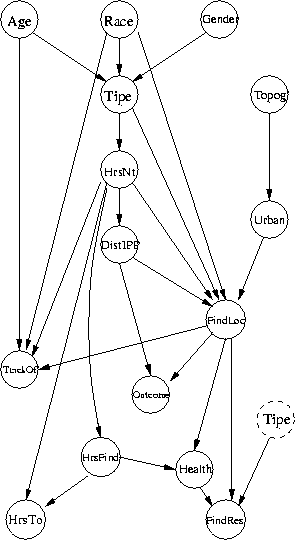
Some variable types...
@0:  Tipe       = Alzheimers | Child |...
@1:  Age
@2:  Race       = ...
@3:  Gender     = ...
@4:  Topography = as above
@5:  Urban      = ...
@6:  HrsNt
@7:  DistIPP
@8:  TrackOffset
@9:  Health     = Well | Hurt | Dead --after!
@10: Outcome    = Find | Suspended | Invalid
@11: FindRes    = Ground | Air |...| Dog
@12: FindLoc    = Brush | Woods |...
@13: HrsFind
@14: HrsTot
|
^ | | | | h | | | | | v | ||||||||||||||||||||||||||
|---|---|---|---|---|---|---|---|---|---|---|---|---|---|---|---|---|---|---|---|---|---|---|---|---|---|---|---|
Components must be autonomous or must cooperate,
For data D and model M,
| Bayes: |
pr(M&D)
|
| Shannon: | msgLen(E) = -log(pr(E)) |
| Wallace: |
msgLen(M&D)
|
| Receiver |
| Transmitter |
| <------------------ |
(NB. MML is not in general identical to MAP,
estNetwork perm estMV dataSet =
 let
   n = (length . selAll) (estMV [])
   search _  []     = []  --done
   search ps (c:cs) =
    --parents ps, children c:cs
    let
      opFlag  = ints2flags [c] n  --child
      ipFlags = ints2flags ps  n  --parents
      cTree = estCTree            --see JFP 2005
                (estAndSelect estMV opFlag)
                (splitSelect ipFlags)
                dataSet dataSet
     in cTree : (search (c:ps) cs)

   trees  = search [] perm       --network
   msgLen = sum (map msg1 trees) --total msg1
   nlP datum = sum (map(\t -> condNlPr t datum datum) trees)
 in
   MnlPr msgLen nlP              --return a Model
         (\() -> "Net:"++(show trees))
  class Project t where      --as in a Projection type
    select :: [Bool] -> t -> t
    ...
Lets us select certain variables (columns), e.g.
  data ModelMV dataSpace = MnlPrMV... --new Model type
  ...

  instance Model ModelMV where ...

  instance Project (ModelMV dataSpace) where ...
  class Splits2 ds where
    splitSelect :: [Bool]->[ds]->[Splitter ds]
  modelMaybe m1 m2 =
    let
      negLogPr (Just x) = nlPr m1 True + nlPr m2 x
      negLogPr Nothing  = nlPr m1 False
    in
      MnlPr (msg1 m1 + msg1 m2) negLogPr
            ...'show' method omitted
-- a useful inductive programming (IP) operator,
  estModelMaybe estModel dataSet =
    let
      present (Just _) = True
      present Nothing  = False
      m1 = uniformModelOfBool          --[*]
      m2 = estModel (map (\(Just x)->x)
                    (filter present dataSet))
    in modelMaybe m1 m
(This is not the same as coding missing as a 'special value'.)
[*] Or alternatively...
m1 = estMultiState (map present dataSet)or even...
m1 = commonKnowledge¿Do you want to model 'missingness', or not?
data Tipe = Alzheimers| Child| Despondent| ...

type Age  = Double
 ...

data Topography = Mountains| Piedmont| Tidewater
        deriving (Ord, Enum, Bounded,...)
 ...


type MissingPerson = (Maybe Tipe, Maybe Age, ... )
--standard Haskell-98.
e0 = estModelMaybe estMultiState            --Tipe

e1 = estModelMaybe(estNormal 0 90 1 70 0.5) --Age

 ... etc.

estMissingPerson = estVariate15 e0 e1 e2 e3 e4 e5 e6
                      e7 e8 e9 e10 e11 e12 e13 e14
 ...

instance Splits Topography where splits = splitsBE

                    --or alternatively  = splitsOrd
 ... etc.
splitsBE --for Bounded Enum types,
splitsOrd --for Ord types
Also implemented 'setSplits' for high-arity Bounded Enum types.
dataSet = read (readFile theDataFile)
          :: [MissingPerson]              --input

nw = estNetwork [1,2,3,0,4,5,6,7]
                estMissingPerson dataSet  --model

nullModel = estMissingPerson dataSet      --null